You Have a lot to Offer: Let’s Take a Skills Inventory

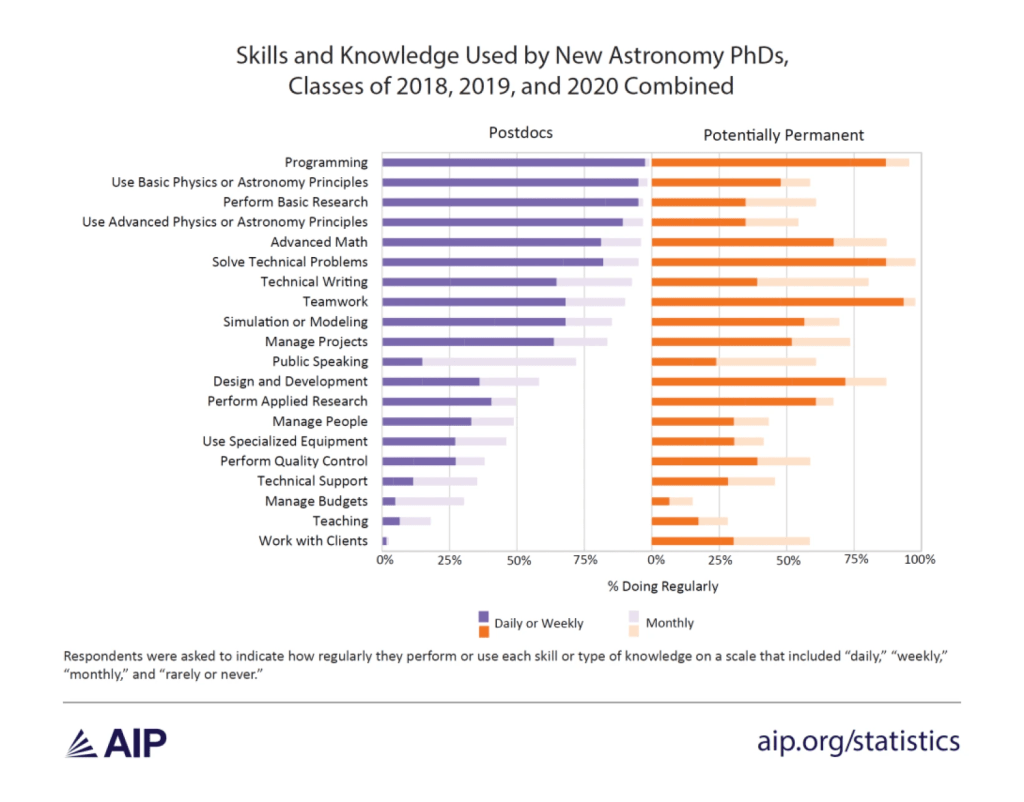
Given that physics is a broad scientific discipline, most students develop expertise with a great variety of scientific instruments, techniques, and problem solving approaches. These kinds of technical skills qualify physicists for diverse types of jobs. Examples include
- Applied research
- Technical problem solving
- Teaching
- Programming
- Documentation
- Data and Error Analysis
- Advanced mathematics
- Simulation and modeling
- Design and development
- Using specialized equipment
- Quality control
At the same time, there are a host of non-technical skills which are used by physicists working in every sector— a university professor, a research scientist at a company, or a staff scientist at a national lab— and they are often more difficult to teach than the scientific and technical skills. These include:
- Writing concisely and accurately
- Tailoring your message to an audience
- Managing/leading groups of people
- Managing projects (creating task lists, developing timelines, setting goals, etc.)
- Planning for and obtaining necessary resources (e.g. funding)
- Developing and managing budgets
- Working on a team
These are skills which are at the core of success in any field you decide to pursue, and you can actively cultivate these skills as you move through your educational career.

Assessing your own skills and knowledge
As a college freshman studying physics, you’re already developing valuable skills, even if you’ve never had a job. It’s crucial to start recognizing and articulating these skills early. This process helps you understand your strengths and prepares you for future internships and jobs. Begin by identifying abilities you’re gaining through coursework, lab work, and extracurricular activities. Learn to describe these skills in ways that appeal to employers. Regularly update this list as you progress through college. This ongoing self-assessment will help you create strong resumes, write effective cover letters, and perform well in interviews when you start applying for internships and jobs. By understanding and communicating your capabilities, you’ll be better prepared to find opportunities that match your skills and interests, even without prior work experience.
Learning Objective: list technical and non-technical skills that you have and hope to learn throughout your time as a physics major.
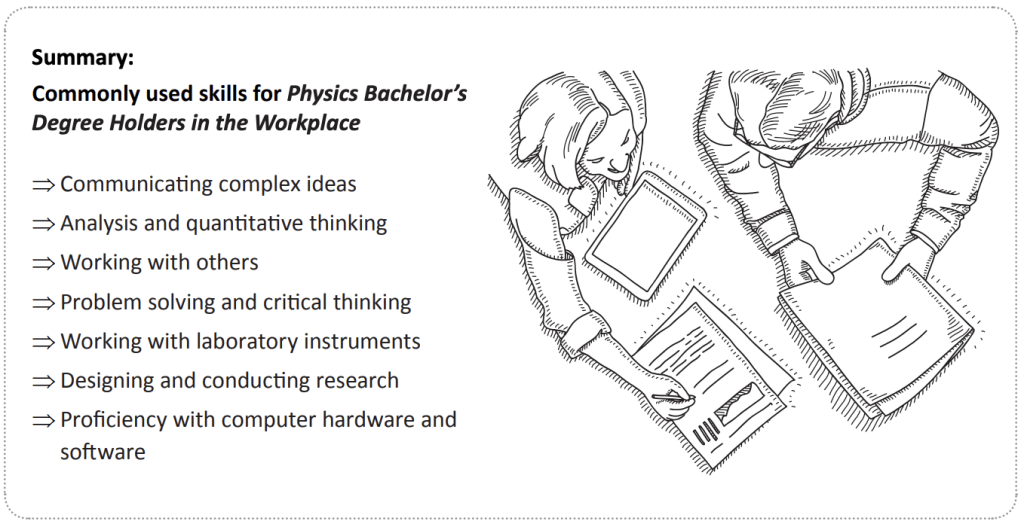
Skill: Working with laboratory instruments
Students who are pursuing a major in physics often have a wide variety of laboratory experiences. Virtually all physics curricula require students to take a lab with the introductory courses and as a part of a senior thesis or a capstone project. Many physics departments have labs during the 2nd and 3rd years as well. Astronomy courses are often laboratory-based. In addition, many students participate in research experiences that deal extensively with research equipment or computer programing. Through these experiences, students learn how to use a variety of different instruments (e.g., optical components, electronics, machine shop tools, vacuum systems, telescopes, spectrographs) and often develop skills related to their operation, maintenance, repair, quality control, and troubleshooting.
Skill: Conducting research
Many physics majors participate in open-ended research. This includes on-campus experiences with professors, off-campus research experiences (maybe as part of a Research Experience for Undergraduates program or an internship), working on an independent research project, or working on a project for a specific course. Research experiences engage students in higherorder thinking skills and complex knowledge, including research design, data analysis, creative thinking, critical thinking, error analysis, and problem solving. An often-overlooked skill developed through conducting research is the ability to find, read, analyze, and interpret relevant background information to simplify a problem. Physics majors are trained in encountering problems that cannot be solved by an online search or looked up in a book. This is useful in a wide variety of settings.
Skill: Proficiency with computer hardware and software
Studying and conducting research in physics often provides opportunities for students to develop knowledge and skills in computer hardware and software. Many physics majors write new code or modify existing programs, use statistical analysis software, or use modeling, image processing, and simulation techniques for research activities. In addition, many students use programs like LabVIEW or Python to run equipment, take data, or build specialized interfaces for this purpose. Programming is a valuable skill.
Skill: Effective communication of complex ideas
All students need to develop good written and oral communication skills during their undergraduate career. Physics students are no exception. You have likely had a a lot of experience presenting complex information or ideas to a wide variety of audiences. Beyond the general education requirements, physics students usually develop written communication skills through writing technical lab reports and research papers that are part of the required curriculum. Physics students may also have the opportunity to publish research in a professional journal or to write about science for a nontechnical audience, e.g., a school newspaper or website. Oral communication skills are developed when you present research or class work via a talk or poster presentation – another common experience for physics students. Students in physics often further develop these skills through regular presentations to a research group or as part of a journal club. Many students also attend regional or national professional meetings where they present research findings.
Skill: Analysis and quantitative thinking
Physics students have a demonstrated ability to apply mathematics to a variety of practical problems in industry and otherwise. When seeking employment in a science, technology, engineering, and mathematics (STEM) field, application and synthesis are especially important. Employers value the analytical skills that help people manage information effectively, think logically, and interpret data. The ability to analyze quantitative data helps in examining a problem thoroughly and developing potential solutions. The quantitative physics intuition that students possess is developed over years of physics coursework, endless hours of homework, and unique problems. The ability to analyze information and determine what is and is not relevant is also developed over years of laboratory work and problem solving. Merely knowing what one doesn’t know can be a huge asset in the workplace.
Skill: Working with others
Many students are members of a research team, are active in campus organizations like the Society of Physics Students, and have extensive experience with group projects. Do not underestimate the importance of these experiences and skills. Teamwork, collaboration, leadership, and decision making are important skills to employers that are evidenced by examples of effective group work. Working with others is often one of the most challenging aspects of a job. Developing this skill takes many forms: from helping to put on a demo show to designing a set of experiments.
Skill: Problem solving and critical thinking
Underlying many of these skills is the ability to examine a situation, identify problems, and think creatively about potential solutions. Physics students do this again and again in labs, research, group projects and homework. You have also learned how to find solutions through literature and online searches, collaborating with colleagues, experiments, and reasoning. This skill is incredibly valuable to all types of employers because problem solvers save employers time and money.
Important notes about this list: Each entry on this short list should be considered as a “set” of skills. You may have several specific skills that fall into a particular skill set ‘category’. Also note that this list is not exhaustive. There are a number of other important skills that you might possess and that may be useful to a potential employer. This list represents data obtained by surveying physics bachelor’s degree holders who have entered the workplace, and should be considered as a starting point.
Let’s personalize it!
Take time to inventory all of the possible skills and experiences you have acquired in your lifetime and don’t leave anything out! Did you volunteer with a student organization and acquire some leadership skills? Perhaps you tutored in your free time and have become better at explaining complex topics as a result. Even experiences that don’t seem relevant could someday give you an extra edge on a job application.
Brainstorm away.

The first step is to make an exhaustive list of your experiences that may have some relevance in a job. Your life experience is NOT just a list of courses. Instead, focus on the skills/knowledge that you achieved in the classes/labs, etc. The same is true for any work experience (whether paid or volunteer), leadership experiences, clubs, events sponsored by organizations in which you have been actively involved…and many others. Keep a master list of everything you’ve done because you won’t remember everything months or years later.
Be specific.

Focus on making notes about the experience AND the knowledge/skills gained. This means making notes about your level of expertise or breadth of experience that has led to a skill or some knowledge that you possess. Even a few sentences can be helpful down the road. Projects are great items to illustrate your skills.
Make use of your immediate network – your classmates and colleagues.

Consider working with a group. This is a great exercise to do with a study group, or even in an SPS chapter meeting. Working with a group of students who have shared classes, labs, and extracurricular activities with you can be a great way to help remember all the things that you have accomplished as a student. It can also give you ideas about things you might need to work on to expand your experience and increase your set of knowledge and skills.
Exercise: Take an inventory and list your skills.
For each skill, you should also think about your proficiency level. Are there any skills missing from your list that you want to build?
 Physics Education Research at UNG