
Wayfinding: What Energizes You?
Last week you began thinking about your physics origin story and what it means to design your own path. This week we’ll dig into the first Design Your Life tool: Energy Mapping. The goal is simple — start paying attention to how your daily activities affect your energy and engagement. This awareness will help you make better decisions about your time, your commitments, and your future in physics.
By the end of today, you will:
- Design a small prototype experiment to learn more about yourself
- Understand how to track energy in your daily life
- Identify patterns in what excites you and what drains you
Back_to_Table_of_Contents
Welcome & Debrief

What is one thing that stuck with you from last week’s class?
What is one new thought about your path in physics since we met?
Thoughts about Your Path in Physics

After sharing this with a partner in class, submit this to the discussion thread in D2L.
You have the option to post anonymously in D2L, if you choose.
Tie-in to learning goals:
- Goal 6: Communicating evolving identity
- Goal 5: Building habits for reflection and participation

This connects to our goals by encouraging reflection on what gives and drains your energy, helping you design your own path in physics. It also builds community by sharing in class and practicing honest reflection.
🔍 Mini-Lesson: Energy Mapping
Purpose: Introduce students to the idea of tracking what activities give or drain their energy, why it matters, and how to start collecting useful data about themselves.
Think about yesterday — was there a moment when you felt really energized? And a moment when you just wanted to crawl under a blanket? What were you doing in those moments?
This is part of the Empathize step — understanding yourself deeply before making big decisions.
- Energy is a clue about alignment between you and the activity.
- Energizing ≠ easy; draining ≠ hard — sometimes hard things energize us.
- By tracking energy, you start to see patterns you can use to shape your schedule and decisions.
Data Collection: use an Energy Log
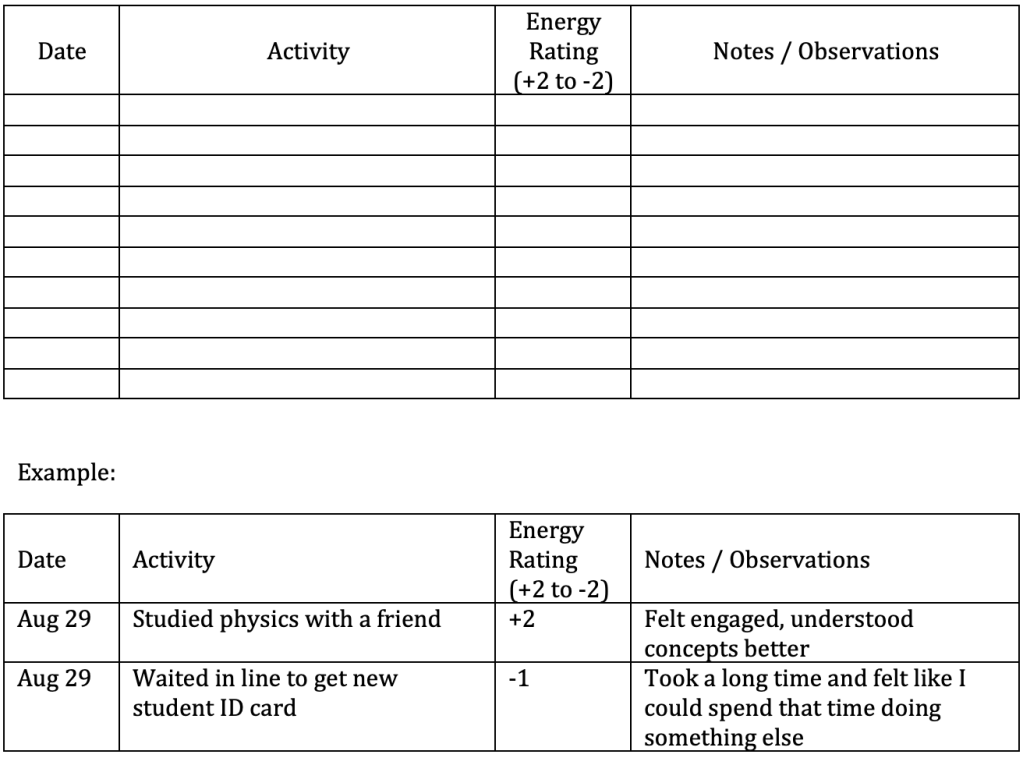
Important — This is data collection, not self-critique.
If you discover group problem-solving is consistently high-energy, maybe that’s a clue about the type of work environment you want.
If all your high-energy moments happen in the lab, maybe research is a good fit.
If writing about science drains you, you can decide whether that’s a skill to develop or something to avoid in your career.
This connects to our goals by giving you a practical tool for noticing where your motivation and curiosity come from. It ties directly to self-discovery and prepares you to design college experiences that align with your interests.
⌛ Activity: Today’s Energy Snapshot
Purpose: Give students a quick, low-stakes way to practice rating activities before committing to a week-long tracking prototype.
We’re going to capture your energy for just the last 6-8 hours — a mini snapshot of your day. This will give you practice before you do the week-long version.
Time column: Fill in from the time you woke up until now in half-hour or hour blocks.
Activity column: Write what you were doing (keep it simple).
Energy rating: Use the +2 to –2 scale:
- +2 = very energizing
- +1 = somewhat energizing
- 0 = neutral
- –1 = somewhat draining
- –2 = very draining
Notes/observations (optional): Add quick details (e.g., “tired from staying up late,” “fun conversation,” “hungry”).
| Time | Activity | Energy | Notes |
|---|---|---|---|
| 7–8am | Ate breakfast | +1 | Coffee helped |
| 8–9am | Walked to campus | +2 | Listened to podcast |
| 9–10am | Math class | +1 | Liked group problem work |
| 10–11am | Scrolled social media | –1 | Bored, procrastinating |
Over the next week, you’ll do this for your whole day each day. The goal is to see what gives you energy, what drains you, and what patterns you find. Then you can make small changes or try new things to learn more about yourself.
📝 Design Your Prototype Assignment
Purpose: Help students leave class with a clear, personalized plan for completing their first week-long prototype — tracking their energy across all daily activities.
That quick snapshot you just did is like a test run. Now, we’re going to expand this into a prototype — a week-long experiment to see patterns in what gives you energy and what drains it.
The Assignment:
- You’ll track every activity you do for one week.
- Rate each activity’s energy level on the +2 to –2 scale.
- Keep quick notes about why it felt that way (context matters).
- At the end of the week, look for patterns in your data.
Important tips:
- Don’t obsess over perfection — aim for a good enough record.
- Be honest — this is for you, not for a grade.
- If you forget to record an activity, don’t try to fill in every missed detail from memory. Just start tracking again with whatever you’re doing next. The point is to notice patterns over time, not to have a perfect record.
Students make their own plan
- Format — Will you use the provided Energy Log Template, your own notebook, or a spreadsheet/app?
- Data granularity — Will you track in 30-min, hourly, or event-based chunks?
- Hypothesis — What do you think you’ll notice?
- E.g., “I get more energy from hands-on labs than from lectures.”
- End-use — How will you use this info to make a small change or try something new?
Before you leave class today, post your plan in D2L:
- Which format you’ll use to track your energy.
- How often you’ll record entries.
- One hypothesis about what you’ll discover.
- How you might use your results to make a change or try something new.
This connects to our goals by building peer connections and normalizing the process of experimenting, reflecting, and revising—core to both design thinking and physics learning. It also builds your communication skills by articulating your reflections to others.
🚪 Exit Ticket: Your Energy Forecast
Before you leave today, post your response in the Week 3 Exit Ticket discussion thread on D2L.
What is one activity you expect will be high-energy for you in the next week?
What is one activity you expect will be low-energy or draining in the next week?
Instructions:
- Keep it short — just a sentence or two for each.
- You must post before leaving class today.
- You may post anonymously if you prefer.
- There are no right or wrong answers — this is about your expectations, which we’ll compare to your actual week when you finish your energy log.
Why this matters: This exit ticket gets you to predict your own energy patterns — an important part of self-reflection. When you finish your energy log next week, you can see if your expectations matched reality.

This connects to our goals by helping you pause, reflect, and capture your learning. Recording your reflections in D2L builds a record you can revisit later in the semester when you’re evaluating your growth and proposing your final grade.
⏭ Next Week Preview — September 4
Next week is our first seminar session. You’ll hear from Piper Spraker, Jack Vogel, and David von Meyer, students who participated in summer research experiences this summer.
Your goals for the seminar:
- Listen for moments in the speaker’s story that sound energizing or draining to you.
- Think about how their path connects (or doesn’t connect) to your own possible futures.
- Ask at least one question about their physics journey — how they got here, decisions they made, or challenges they faced.
How it connects to your Energy Log:
- Your week-long log will give you clues about what energizes you. Use that insight to pay closer attention during the seminar to the parts of the speaker’s work or life that align with your own high-energy activities.
🎯 How This Week Connects to Our Learning Goals
This week’s activities are tied to several of our course learning goals:
- Goal 2: Explore a range of possible futures for yourself in physics and beyond
You began noticing patterns in what energizes you, which can guide the kinds of roles, activities, and environments you might pursue in the future. - Goal 3: Prototype and reflect on small, meaningful steps toward your goals
The Energy Log is your first structured prototype of the semester—a small, low-risk experiment to gather self-knowledge and test a new tool for decision-making. - Goal 5: Develop a strong foundation for navigating college and the physics major
Energy mapping gives you a method for balancing commitments, managing time, and preventing burnout by aligning your schedule with what sustains you. - Goal 6: Communicate your evolving identity as a physics student
Through in-class sharing, D2L submissions, and the Exit Ticket, you practiced describing what activities align (or don’t align) with your interests and energy, adding detail to your personal physics story.
 Physics Education Research at UNG