Conductors, Insulators, and Charging by Induction

Practice!
| Practice 1.2.1 |
|---|
 Consider three plastic balls (A, B, and C), each carrying a uniformly distributed charge equal to either +Q, -Q or zero, and an uncharged copper ball (D). A positive test charge (T) experiences the forces shown in the figure when brought very near to the individual balls. The test charge T is strongly attracted to A, strongly repelled from B, weakly attracted to C, and strongly attracted to D. |
| Practice 1.2.2 |
|---|
Consider three plastic balls (A, B, and C), each carrying a uniformly distributed charge equal to either +Q, -Q or zero, and an uncharged copper ball (D). A positive test charge (T) experiences the forces shown in the figure when brought very near to the individual balls. The test charge T is strongly attracted to A, strongly repelled from B, weakly attracted to C, and strongly attracted to D. |
| Practice 1.2.3 |
|---|
Consider three plastic balls (A, B, and C), each carrying a uniformly distributed charge equal to either +Q, -Q or zero, and an uncharged copper ball (D). A positive test charge (T) experiences the forces shown in the figure when brought very near to the individual balls. The test charge T is strongly attracted to A, strongly repelled from B, weakly attracted to C, and strongly attracted to D. |
| Practice 1.2.4 |
|---|
Consider three plastic balls (A, B, and C), each carrying a uniformly distributed charge equal to either +Q, -Q or zero, and an uncharged copper ball (D). A positive test charge (T) experiences the forces shown in the figure when brought very near to the individual balls. The test charge T is strongly attracted to A, strongly repelled from B, weakly attracted to C, and strongly attracted to D. |
| Practice 1.2.5 |
|---|
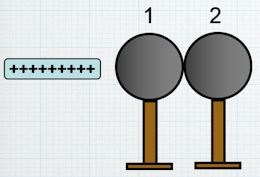 Two uncharged metal spheres located on top of insulating poles are initially in contact as shown. A positively charged insulator is brought close to sphere 1 without touching and removed, and then the spheres are separated. |
| Practice 1.2.6 |
|---|
Two uncharged metal spheres located on top of insulating poles are initially in contact as shown. A positively charged insulator is brought close to sphere 1 without touching and then the spheres are separated before the positively charged insulator is removed. |
 Physics Education Research at UNG