Activity 1 — Charging an Insulator
This activity explores the behavior of charge on realistic (i.e. non-ideal) insulators. We take as an example a long insulating rod suspended by insulating wires. Assume that the rod is initially electrically neutral. For convenience, we will refer to the left end of the rod as end A, and the right end of the rod as end B.
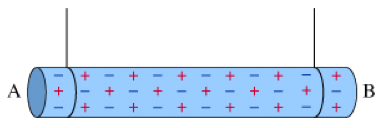
1. A small metal ball is given a negative charge, then brought near (i.e., within a few millimeters) to end A of the rod.

What happens to end A of the rod when the ball approaches it closely this first time?
2. Now consider what happens when the small metal ball is repeatedly given a negative charge and then brought into contact with end A of the rod. After several contacts with the charged ball, how is the charge on the rod arranged?
3. How does end A of the rod react when the ball approaches it after it has already made several contacts with the rod, such that a fairly large charge has been deposited at end A?
 Physics Education Research at UNG