Magnetic Fields Produced by Currents: Biot-Savart Law and Ampere’s Law
Source of Magnetic Fields
So far we’ve talked about the force that is exerted by a magnetic field on a moving charge. But we haven’t talked about where that magnetic field comes from, aside from a brief discussion on permanent magnets. But the magnetic fields we interact with every day (even though you might not know you’re dealing with B-fields) come from electric currents. Just like electric charge is the source of E-fields, electric current is the source of B-fields.
I will give you some examples of B-fields produced by currents and how to calculate the strength of the field. But we will have to just list out the examples, because deriving the formulas requires calculus. Please know that each of the formulas I give you all come from one fundamental law, called the Biot-Savart law, which is used to determine the magnetic field produced by a moving charge. Sometimes people think that physics is just an endless list of formulas, but that’s not really true. Most every formula we have is derived from one of just a handful of fundamental laws. I just needed to put that out there, now let’s get on with the examples…
Practice!
Practice 10.3.1
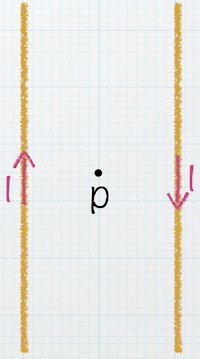
What is the direction of the magnetic field at point P, which is exactly in the middle of two parallel wires carrying equal currents I in opposite directions?
Check your answer: A. Goes into the page
Practice 10.3.2
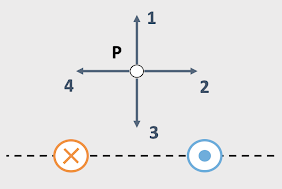
If the currents in these wires have the same magnitude but opposite directions, what is the direction of the magnetic field at point P?
Check your answer: C. Direction 3
Practice 10.3.3
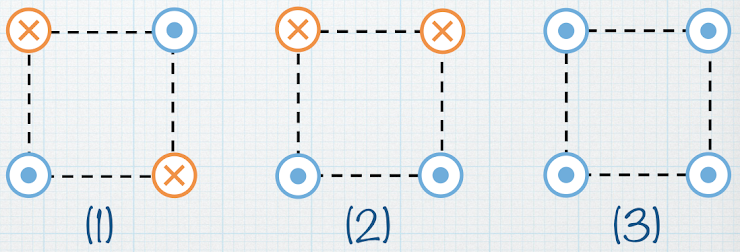
Each of the wires in the figures below carry the same current, either into or out of the page. In which case is the magnetic field at the center of the square greatest?
Check your answer: B. Arrangement 2
Practice 10.3.4
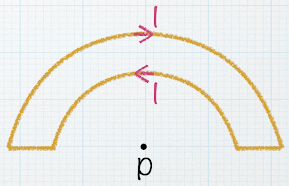
What is the direction of the magnetic field at point P, which is at the center of a semicircular loop of wire carrying a current I as shown?

 Physics Education Research at UNG