Activity 1 — Magnetic Force on a Current Carrying Conductor
In the following series of questions, there is a current-carrying straight wire segment (with connecting wires up and out of the page that are not shown) in a uniform magnetic field directed out of the page.
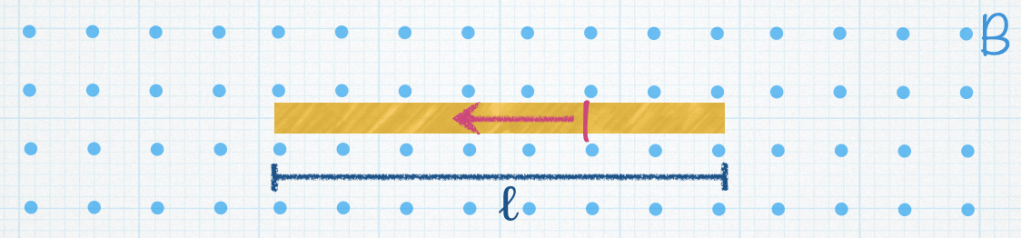
First, what is the direction of the magnetic force acting on the wire segment due to the uniform magnetic field?
What would the direction of the magnetic force acting on the wire segment be if the direction of the uniform magnetic field were into the page?
What would happen to the magnitude of the magnetic force acting on the wire segment if the wire segment were longer but still completely within the uniform magnetic field?
What would the direction of the magnetic force acting on the wire segment be if we reversed the direction of the current in the wire segment (assuming the B-field is still out of the page)?
What would happen to the magnitude of the magnetic force acting on the wire segment if the wire segment were moved without changing its orientation so that its length was half-in and half-out of the uniform magnetic field region?
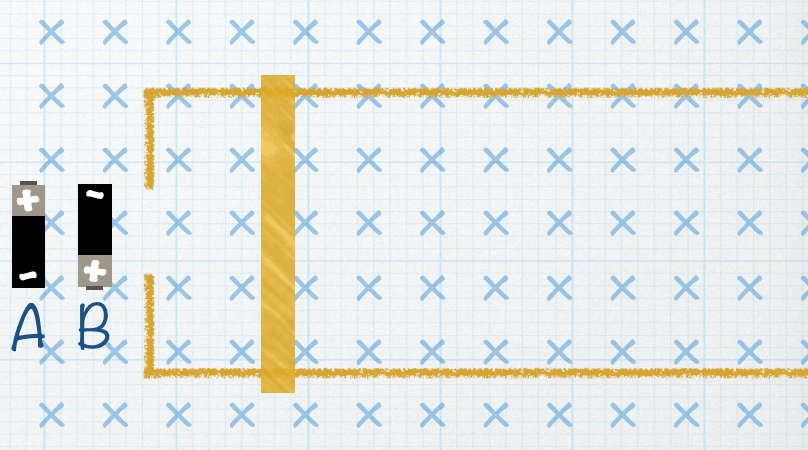
The figure shows a top view of two conducting rails on which a conducting bar can slide. A uniform magnetic field is directed perpendicular to the plane of the figure as shown (into the page, X). A battery is to be connected to the two rails so that when it’s connected, current will flow through the bar and cause a magnetic force to push the bar to the right. In which orientation, A or B, should the battery be placed in the circuit to result in a magnetic force on the bar that pushes it to the right?
 Physics Education Research at UNG