Consider the situation in the figure. A wire is connected to the input and ground terminals of a voltmeter and formed into a circular loop with two turns. A bar magnet is held at the center of the loop. In order to change the magnetic flux through the loop, what could you do?
Check your answer: E. all of the above
Practice 11.1.2
Consider the situation in the figure. A wire is connected to the input and ground terminals of a voltmeter and formed into a circular loop with two turns. A bar magnet is held at the center of the loop. In order to change the magnetic flux through the loop, what else could you do?
Check your answer: D. only (A) and (B)
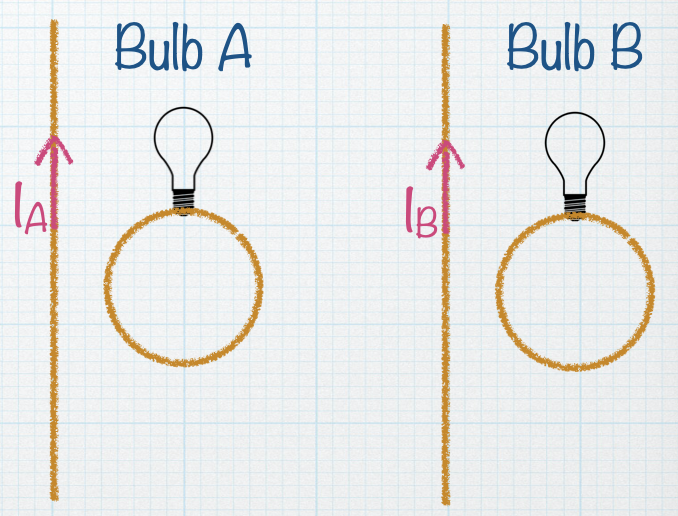
Two circular loops of wire with small bulbs in them are sitting beside two long straight current-carrying wires. The loops with the bulbs have no battery or power supply, they are simply wires with bulbs. The long straight wires are connected to batteries not shown, but that is where the currents I1 and I2 come from. Recall from the last module that currents in a long straight wire produce magnetic fields that circulate around them with a magnitude of . The wire loops, bulbs, and long straight wires are identical for the two cases. The loops are the same distance from the straight wires. But situation A is isolated from situation B, they have no effect on each other. We are going to look at different scenarios and predict what will happen to the bulb.
In each of the following questions, determine if the bulbs will light up.
Practice 11.1.3
There is a constant current in wire A of 6 A (amperes) and a constant current in wire B of 15 A.
Check your answer: C. Neither bulb is lit
Practice 11.1.4
Both wires start with the same initial 3-A current, but the current in wire B increases to 6 A in a 0.3 second interval while the current in A remains constant.
Check your answer: B. Only bulb B is lit
Practice 11.1.5
The current in wire A goes from 2 A to 10 A in a 0.5 second interval, while at the same time, the current in B goes from 12 A to 16 A.
Check your answer: E. Both bulbs are lit and bulb A is brighter
Practice 11.1.6
The current in wire A decreases from 10 A to 4 A in a 0.2 second interval, while the current in wire B increases from 9 A to 18 A in 0.3 seconds.
Check your answer: D. Both bulbs are lit and are equally bright
Practice 11.1.7
The current in wires A and B both double in a 0.2 second interval, but the current in wire A starts at twice the initial value of B.
Check your answer: E. Both bulbs are lit and bulb A is brighter
Practice 11.1.8
A 144-Ω light bulb is connected to a conducting wire that is wrapped into the shape of a square with side length of 83.0 cm. This square loop is rotated within a uniform magnetic field of 454 mT. What is the change in magnetic flux through the loop when it rotates from a position where its area vector makes an angle of 30° with the field to a position where the area vector is parallel to the field?
Check your answer: D. 41.9 mWb
Practice 11.1.9
A 144-Ω light bulb is connected to a conducting wire that is wrapped into the shape of a square with side length of 83.0 cm. This square loop is rotated within a uniform magnetic field of 454 mT. The loop rotates from a position where its area vector makes an angle of 30° with the field to a position where the area vector is parallel to the field in 56.3 ms. What is the induced current through the light bulb?
Check your answer: C. 5.17 mA
Practice 11.1.10
A 144-Ω light bulb is connected to a conducting wire that is wrapped into the shape of a square with side length of 83.0 cm. This square loop is rotated with a frequency of 60 Hz within a uniform magnetic field of 454 mT. This means the loop makes half a revolution in 8.33 ms. What is the induced current in the light bulb when the loop rotates from a position where its area vector is opposite the magnetic field to a position where its area vector is parallel to the magnetic field?

 . The wire loops, bulbs, and long straight wires are identical for the two cases. The loops are the same distance from the straight wires. But situation A is isolated from situation B, they have no effect on each other. We are going to look at different scenarios and predict what will happen to the bulb.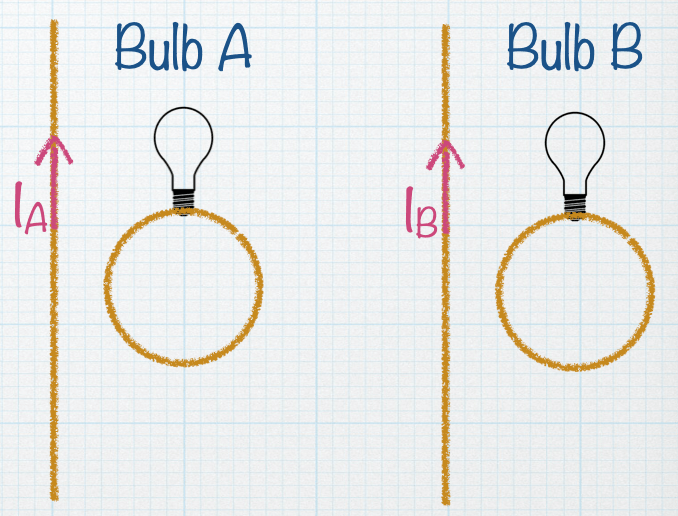
 Physics Education Research at UNG