Activity 1
A Brief Review of Waves
I thought it would be helpful to remind you of some things about waves, since we will use them in this module. Let’s define some stuff:
Let’s start with the stuff related to time. We can look at a transverse wave and watch how a point on that wave moves up and down in time. How far it moves up and down from the equilibrium position is called the amplitude, A.
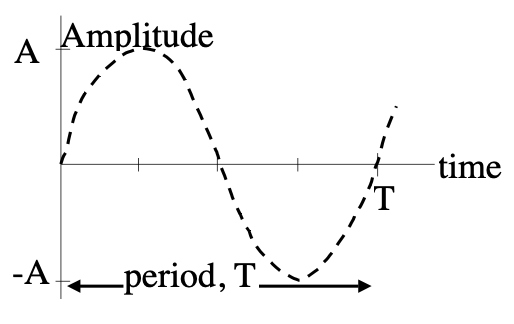
We can plot this up-and-down motion as a function of time. The amount of time it takes the point to move all the way up, then all the way down and then back to where it started, this time is called the period, T.
T = period, measured in seconds, and it’s the amount of time to complete one cycle.
If you take the inverse of the period, this is called the frequency, which is measured in hertz, Hz, or cycles per second.
f = 1/T = frequency, measured in Hz, or 1/s
We also have the angular frequency, ω, which is like the frequency, f, but with different units.
ω = 2πf = 2π/T = angular frequency, measured in rad/s.

Practice!
| Practice 13.1.2 |
|---|
 What is the period of the wave? |
| Practice 13.1.3 |
|---|
What is the frequency of the wave? |
| Practice 13.1.4 |
|---|
What is the angular frequency of the wave? |
Alternatively, you can take a “snapshot” at some fixed time t. Then you can graph the vertical position of particles on the wave as a function of horizontal position.

The wavelength, λ, is the distance from maximum to maximum or minimum to minimum (like in this picture). Sometimes we say it’s measured from crest to crest or trough to trough. The wavelength is measured in meters, since it is a distance.
λ = wavelength, measured in meters
If you take another “snapshot” a moment later, this wave will have moved (to the right, if that’s the direction of travel) a distance equal to x. In a time equal to one period, T, the wave moves a distance equal to one wavelength, λ. So we can use this distance and time to find the speed of the wave:
vwave = λ/T = distance / time
And another way we can write this wave speed is if we substitute f = 1/T:
vwave = λf
This is the speed of any wave, it doesn’t matter if it’s a sound wave, a water wave, or an electromagnetic wave. Every wave will have a speed equal to its wavelength times its frequency. This will be very convenient when we discuss EM waves, because we know the speed of an EM wave is c = 3 x 10⁸ m/s. We can use this value and the relationship that c = λf for EM waves to relate the wavelength and frequency of EM waves.
| Practice 13.1.5 |
|---|
| The speed of sound in air is a bit over 300 m/s and the speed of light in air is about 300,000,000 m/s. Suppose we make both a sound wave and light wave that both have a wavelength of 3 m. What is the ratio of the frequency of the light wave to that of the sound wave? |
 Physics Education Research at UNG