Light of frequency 6.00 × 10¹⁴ Hz illuminates a soap film (n = 1.33) having air on both sides of it. When viewing the film by reflected light, what is the minimum thickness of the film that will give an interference maximum when the light is incident normally on it?
Check your answer: E. 94.0 nm
Calculate the minimum thickness of a soap-bubble film (n = 1.33) that results in constructive interference in the reflected light if the film is illuminated with light whose wavelength in air is λ = 460 nm. What are the next two thinnest film thicknesses that will produce constructive interference?
Practice 20.1.2
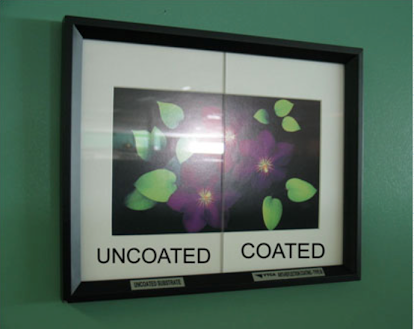
The antireflective glass shown is covered with a thin layer of magnesium fluoride (n = 1.38). The index of refraction of the glass is 1.52. What minimum thickness of magnesium fluoride is needed to cause destructive interference of light whose wavelength is in the middle of the visible range at 555 nm?
Check your answer: B. 100 nm
Practice 20.1.3
A thin layer of oil (n = 1.25) is floating on water (n = 1.33). What is the minimum nonzero thickness of the oil in the region that strongly reflects green light (λ = 530 nm)?