Electric Potential Energy and Potential Difference

Practice!
| Practice 3.1.1 |
|---|
Two test charges are brought separately into the vicinity of a charge +Q. First, test charge +q is brought to a point a distance r from +Q. Then this charge is removed and test charge -q is brought to the same point.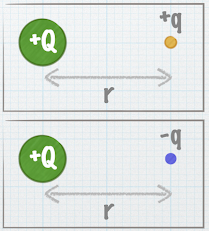 The electrostatic potential energy of which test charge is greater? |
| Practice 3.1.2 |
|---|
 A proton and an electron are in a constant electric field created by oppositely charged plates. You release the proton from the positive side and the electron from the negative side. Which feels the larger electric force? |
| Practice 3.1.3 |
|---|
A proton and an electron are in a constant electric field created by oppositely charged plates. You release the proton from the positive side and the electron from the negative side. Which has the larger acceleration? |
| Practice 3.1.4 |
|---|
A proton and an electron are in a constant electric field created by oppositely charged plates. You release the proton from the positive side and the electron from the negative side. When it strikes the opposite plate, which one has more KE? |

Discuss!
Reflect on these questions and take notes on how you would answer them. Then we will share these thoughts together in a class discussion.
At the instant shown, a positively charged particle is moving at 5 m/s in the direction of a uniform electric field. Someone makes the following statement: “As the particle continues to move in the direction of the electric field, the particle will gain potential energy since it is moving in the direction of increasing electric potential energy.”
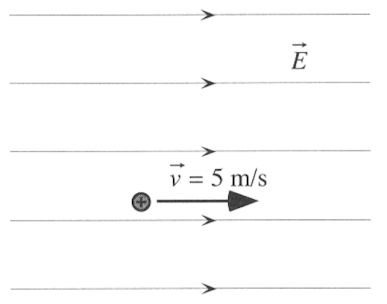
What, if anything, is wrong with the above statement? If something is wrong, explain the error and how to correct it. If the statement is valid, explain why.
 Physics Education Research at UNG