Activity 3: Electromotive Force (emf) and Terminal Voltage
| Practice 7.2.1 |
|---|
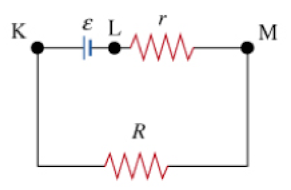 For the circuit shown where r is an internal resistance and R is an external resistor, which potential difference corresponds to the terminal voltage of the battery? |
| Practice 7.2.2 |
|---|
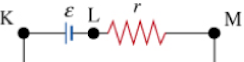 A battery has emf = 12.0 V and internal resistance = 3.00 Ω. A voltmeter is connected to the terminals of the battery; the battery is not connected to any other external circuit elements. What is the reading of the voltmeter? |
| Practice 7.2.3 |
|---|
A battery has emf = 12.0 V and internal resistance r = 3.00 Ω. A 21.0-Ω resistor is connected to the terminals of the battery. What is the current through the battery? |
| Practice 7.2.4 |
|---|
A battery has emf = 12.0 V and internal resistance r = 3.00 Ω. A 21.0-Ω resistor is connected to the terminals of the battery. What is the current through the 21.0-Ω resistor? |
| Practice 7.2.5 |
|---|
A battery has emf = 12.0 V and internal resistance r = 3.00 Ω. A 21.0-Ω resistor is connected to the terminals of the battery. What is the potential difference across the 21.0-Ω resistor? |
| Practice 7.2.6 |
|---|
A battery has emf = 12.0 V and internal resistance r = 3.00 Ω. A 21.0-Ω resistor is connected to the terminals of the battery. What is the terminal voltage of the battery connected to the 21.0-Ω resistor? |

