First, let’s define something. You know how we call electric fields ? Well, magnetic fields get their own symbol too, and it’s . I know, it’s not M, for magnetic? It’s not. This is due to historical reasons that I won’t go too deep into here. But when James Clerk Maxwell was developing his theory of electromagnetism, he was naming the vector fields and he did so alphabetically. There’s an field, a field, and so on. It just so happens that the electric field was conveniently named the field and the magnetic field got stuck with the name: the field.
We know that permanent magnets exist in nature, and we also now know from Oersted’s experiments that an electric current is a source of magnetic field too. In this image you can see the magnetic field lines (blue lines with arrows labeled ) for different magnets.
One thing to note about magnetic field lines is that they are always closed loops. This is very different from electric field lines (E-fields start at positive charge and end at negative charge) because B-field lines don’t start or end, they are continuous. Look at the bar magnet (a) in the figure above. Outside the magnet, the B-field lines go from N to S and inside the magnet the B-field lines go from S to N. You can see a similar pattern in the other B-fields too.
Magnetic Force (Lorentz Force)
There are three experimental observations about the magnetic force, which are essentially rules about the force:
An electric charge (q) can experience a magnetic force only if it is moving in a magnetic field.
If the electric charge is moving parallel to the B-field, the charge will not experience a magnetic force.
The magnetic force on an electric charge moving through a B-field is always perpendicularto both the velocity of the charge and the B-field vector.
Pause & Predict 9.3.1
What is the speed of the charged particle?
Pause & Predict 9.3.2
What is the direction of the force on the positive charge?
Pause & Predict 9.3.3
What is the magnitude of the magnetic field?
Practice!
Practice 9.3.1
A uniform magnetic field points upward, parallel to the page, and has a magnitude of 7.85 mT. A negatively charged particle (q = -3.32 µC, m = 2.05 ng) moves through this field with a speed of 67.3 km/s at a 42° with respect to the magnetic field, parallel to the page as shown. What is the magnitude of the magnetic force on this particle?
Check your answer: B. 1.17 mN
Practice 9.3.2
A uniform magnetic field points upward, parallel to the page, and has a magnitude of 7.85 mT. A negatively charged particle (q = -3.32 µC, m = 2.05 ng) moves through this field with a speed of 67.3 km/s at a 42° with respect to the magnetic field, parallel to the page as shown. What is the direction of the magnetic force on this particle?
Check your answer: F. Into the page
Practice 9.3.3
A uniform magnetic field points upward, parallel to the page, and has a magnitude of 7.85 mT. A negatively charged particle (q = -3.32 µC, m = 2.05 ng) moves through this field with a speed of 67.3 km/s perpendicular to the magnetic field, as shown. The magnetic force on this particle is a centripetal force and causes the particle to move in a circular path. What is the radius of the particle’s circular path?
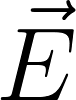 ? Well, magnetic fields get their own symbol too, and it’s
 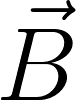 . I know, it’s not M, for magnetic? It’s not. This is due to historical reasons that I won’t go too deep into here. But when James Clerk Maxwell was developing his theory of electromagnetism, he was naming the vector fields and he did so alphabetically. There’s an
  field, a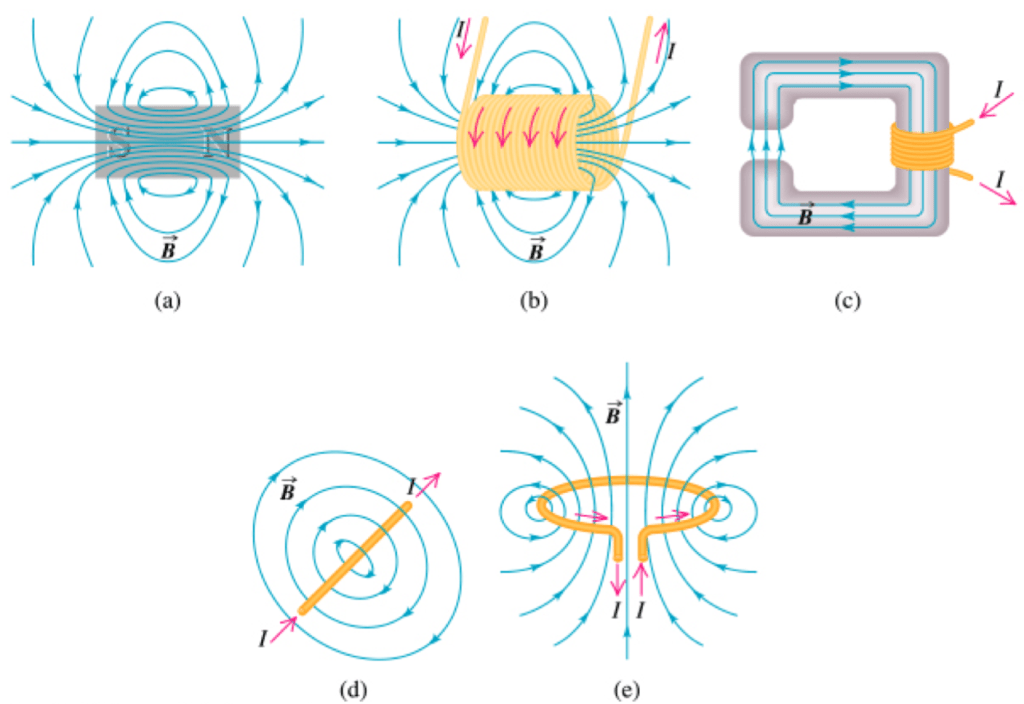


 Physics Education Research at UNG