Self Assessment Practice Quiz 1
| 1.1 |
|---|
| (a) Common static electricity involves charges ranging from nanocoulombs to microcoulombs. How many electrons are needed to form a charge of –2.00 nC? |
| (b) How many electrons must be removed from a neutral object to leave a net charge of 0.500 µC? |
| (c) Suppose a speck of dust in an electrostatic precipitator has 1.0000×10¹² protons in it and has a net charge of –5.00 nC (a very large charge for a small speck). How many electrons does it have? |
| Answer: (a) 1.25 x 10¹⁰ electrons needed (b) 3.125 x 10¹² electrons removed (c) 1.031 x 10¹² electrons (Click and drag over the answer to highlight it) |
| 1.2 |
|---|
| (a) Find the ratio of the electrostatic to gravitational force between two electrons. |
| (b) What is this ratio for two protons? |
| c) Why is the ratio different for electrons and protons? |
| Answer: (a) 4.16 x 1042 (b) 1.24 x 1036 |
| 1.3 |
|---|
What is the force on the charge located at 𝑥 = 8.00 cm in the figure given that 𝑞 = 1.00 μC? |
| Answer: 12.8 N to the right, in the +x direction |
| 1.4 |
|---|
| A test charge of +2 𝜇C is placed halfway between a charge of +6 𝜇C and another of +4 𝜇C separated by 10 cm. |
| (a) What is the magnitude of the force on the test charge? |
| (b) What is the direction of this force (away from or toward the +6 𝜇C charge)? |
| Answer: (a) 14.4 N (b) away from the 6 µC charge |
| 1.5 |
|---|
| Earth has a net charge that produces an electric field of approximately 150 N/C downward at its surface. |
| (a) What is the magnitude and sign of the excess charge on earth, noting the electric field of a conducting sphere is equivalent to a point charge at its center? |
| (b) What acceleration will the field produce on a free electron near Earth’s surface? |
| (c) What mass object with a single extra electron will have its weight supported by this field? |
| Answer: (a) 6.76 x 10⁵ C (b) 2.63 x 10¹³ m/s2 (c) 2.45 x 10⁻¹⁸ kg |
| 1.6 |
|---|
A 5.00 g charged insulating ball hangs on a 30.0 cm long string in a uniform horizontal electric field as shown. Given the charge on the ball is 1.00 𝜇C, find the strength of the field. |
| Answer: 6900 N/C |
| 1.7 |
|---|
The classic Millikan oil drop experiment was the first to obtain an accurate measurement of the charge on an electron. In it, oil drops were suspended against the gravitational force by a vertical electric field. Given the oil drop to be 1.00 𝜇m in radius and have a density of 920 kg/m3 |
| (a) Find the weight of the drop. |
| (b) If the drop has a single excess electron, find the electric field strength needed to balance its weight. |
| Answer: (a) 3.8 x 10⁻¹⁴ N (b) 2.4 x 10⁵ N/C |
| 1.8 |
|---|
A simple and common technique for accelerating electrons is shown in the figure, where there is a uniform electric field between two plates. Electrons are released, usually from a hot filament, near the negative plate, and there is a small hole in the positive plate that allows the electrons to continue moving.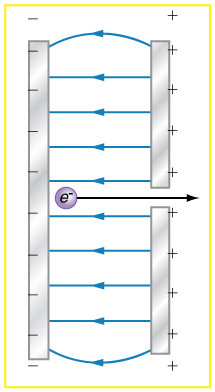 |
| (a) Calculate the acceleration of the electron if the field strength is 2.50 × 10⁴ N/C. |
| (b) Explain why the electron will not be pulled back to the positive plate once it moves through the hole. |
| Answer: 4.39 x 10¹⁵ m/s2 |
| 1.9 |
|---|
 (a) Find the total electric field at 𝑥 = 1.00 cm given that 𝑞 = 5.00 nC. |
| (b) Find the total electric field at 𝑥 = 11.00 cm. |
| Answer: (a) 5.30 x 10⁴ N/C (b) 2.04 x 10⁵ N/C |
| 1.10 |
|---|
| Point charges of 25.0 𝜇C and 45.0 𝜇C are placed 0.500 m apart. |
| (a) At what point along the line between them is the electric field zero? |
| (b) What is the electric field halfway between them? |
| Answer: (a) 0.21 m from the 25 µC charge (b) 2.9 x 10⁶ N/C pointing towards the 25 µC charge |
 Physics Education Research at UNG