Find the ratio of speeds of an electron and a negative hydrogen ion (one having an extra electron) accelerated through the same voltage, assuming non-relativistic final speeds. Take the mass of the hydrogen ion to be 1.67 × 10⁻²⁷ kg.
Answer: speed of electron/speed of H ion = 42.8 (Click and drag over the answer to highlight it)
2.2
A bare helium nucleus has two positive charges and a mass of 6.64 × 10⁻²⁷ kg.
(a) Calculate its kinetic energy in joules at 2.00% of the speed of light.
(b) What is this energy in electron volts?
(c) What voltage would be needed to obtain this energy?
Answer: a) 1.2 x 10⁻¹³ J b) 7.5 x 10⁵ eV c) 3.7 x 10⁵ V
2.3
(a) Will the electric field strength between two parallel conducting plates exceed the breakdown strength for air (3.0 × 10⁶ V/m) if the plates are separated by 2.00 mm and a potential difference of 5.0 × 10³ V is applied?
(b) How close together can the plates be with this applied voltage?
Answer: a) E = 2.5 x 10⁶ V/m and will not exceed the breakdown strength b) 1.7 mm
2.4
The voltage across a membrane forming a cell wall is 80.0 mV and the membrane is 9.00 nm thick. What is the electric field strength? (The value is surprisingly large, but correct. You may assume a uniform electric field.
Answer: 8.9 x 10⁶ V/m
2.5
An electron is to be accelerated in a uniform electric field having a strength of 2.00 × 10⁶ V/m.
(a) What energy in keV (kilo electron volts) is given to the electron if it is accelerated through 0.400 m?
(b) Over what distance would it have to be accelerated to increase its energy by 50.0 GeV?
Answer: a) 800 keV b) 25,000 m
2.6
(a) How far from a 1.00 µC point charge will the potential be 100 V?
(b) At what distance will the potential be 2.00 × 10² V?
Answer: a) 90 m b) 45 m
2.7
In one of the classic nuclear physics experiments at the beginning of the 20th century, an alpha particle (helium nucleus) was accelerated toward a gold nucleus, and its path was substantially deflected by the Coulomb interaction. If the energy of the doubly charged alpha particle was 5.00 MeV, how close to the gold nucleus (79 protons) could it come before being deflected?
Answer: 4.5 x 10⁻¹⁴ m
2.8
(a) What is the capacitance of a parallel plate capacitor having plates of area 1.50 m2 that are separated by 0.0200 mm of air?
(b) What charge does the capacitor hold when 9.00 V is applied to it?
Answer: a) 664 nF b) 6 µC
2.9
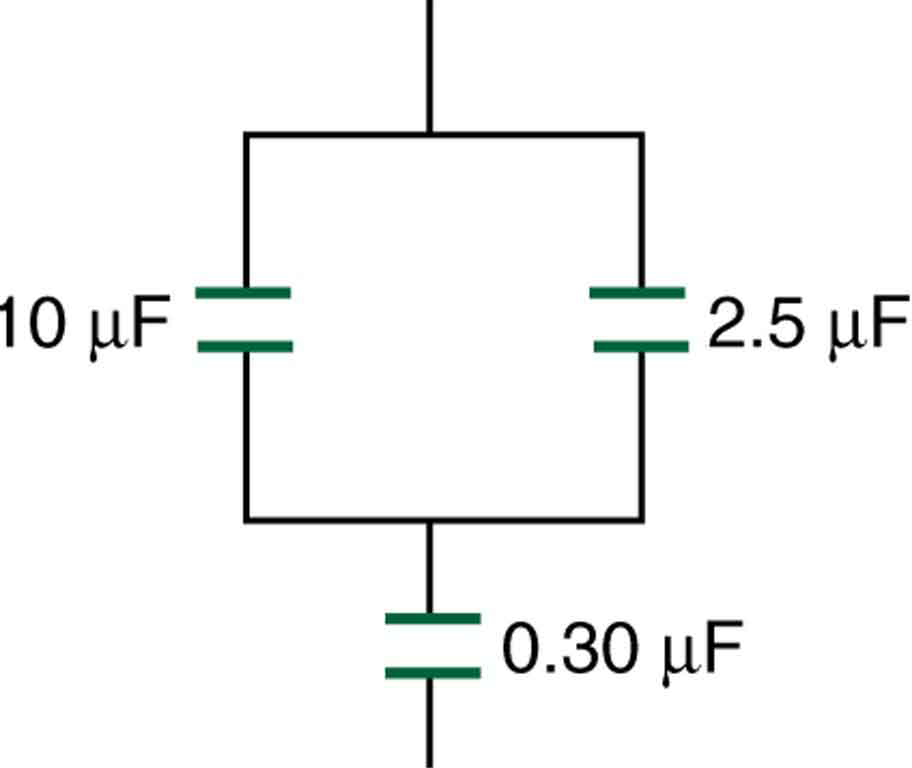
Find the total capacitance of the combination of capacitors in the figure.
Answer: 0.3 µF
2.10
(a) What is the energy stored in the 10.0 μF capacitor of a heart defibrillator charged to 9.00 × 10³ V?
 Physics Education Research at UNG