(a) What is the resistance of a 1.00×10² Ω, a 2.50 kΩ, and a 4.00 kΩ resistors connected in series?
(b) In parallel?
Answer: (a) 6600 Ω (b) 94 Ω (Click and drag over the answer to highlight it)
4.2
An 1800-W toaster, a 1400-W electric frying pan, and a 75-W lamp are plugged into the same outlet in a 15-A, 120-V circuit. (The three devices are in parallel when plugged into the same socket.).
(a) What current is drawn by each device?
(b) Will this combination blow the 15-A fuse?
Answer: (a) Itoaster = 15 A, Ipan = 11.7 A, Ilamp = 0.63 A (b) Yes
4.3
(a) Given a 48.0-V battery and 24.0-Ω and 96.0-Ω resistors, find the current and power for each when connected in series.
(b) Repeat when the resistances are in parallel.
Answer: (a) Current through battery = 0.4 A = current through 24 Ω resistor = current through 96 Ω resistor. Pbatt = 19.2 W, P48Ω = 3.84 W, P96Ω = 15.4 W (b) Ibatt = 2.5 A, I24Ω = 2 A, I96Ω = 0.5 A; Pbatt = 120 W, P24Ω = 96 W, P96Ω = 24 W
4.4
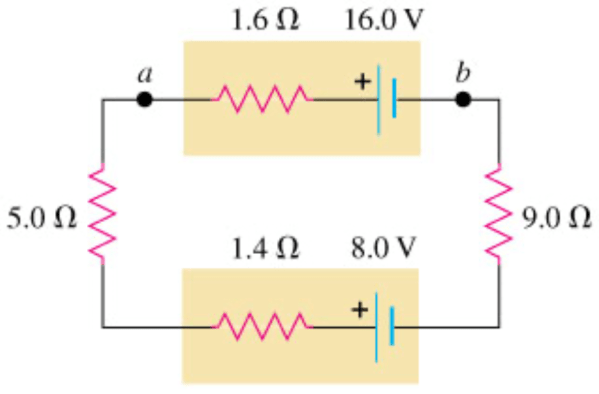
The circuit shown in the figure contains two batteries, each with an emf and an internal resistance, and two resistors.
(a) Find the magnitude of the current in the circuit.
(b) Find the direction of the current in the circuit.
(c) Find the terminal voltage Vab of the 16.0 V battery.
Answer: (a) 0.47 A (b) counterclockwise (c) 15.2 V
4.5
Electric fish generate current with biological cells called electroplaques, which are physiological emf devices. The electroplaques in the South American eel are arranged in 140 rows, each row stretching horizontally along the body and each containing 5000 electroplaques. Each electroplaque has an emf of 0.15 V and internal resistance of 0.25 Ω. If the water surrounding the fish has resistance of 800 Ω, how much current can the eel produce in water from near its head to near its tail?
Answer: 0.93 A
4.6
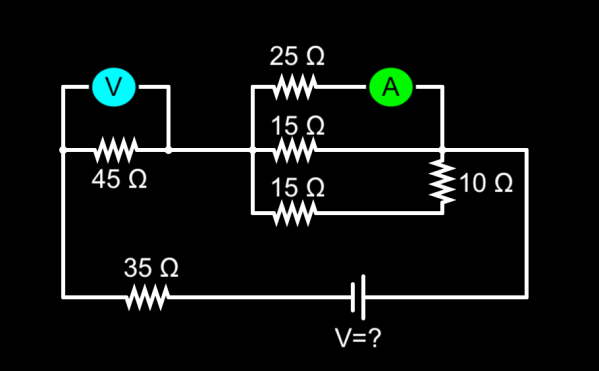
For the circuit shown, the battery has no appreciable internal resistance, and the ammeter reads 1.25 A.
(a) What does the voltmeter read?
(b) What is the voltage of the battery?
Answer: (a) 206 V (b) 398 V
4.7
In the circuit shown in the figure, both batteries have insignificant internal resistance and the idealized ammeter reads 1.40 A in the direction shown.
(a) Find the emf of the battery.
(b) Is the polarity shown correct? Explain.
Answer: (a) 55 V (b) Yes
4.8
A heart pacemaker fires 72 times a minute, each time a 25.0-nF capacitor is charged (by a battery in series with a resistor) to 0.632 of its full voltage. What is the value of the resistance?
Answer: 3.32 MΩ
4.9
A 500-Ω resistor, an uncharged 1.50-μF capacitor, and a 6.16-V emf are connected in series.
(a) What is the initial current?
(b) What is the 𝑅𝐶 time constant?
(c) What is the current after one time constant has elapsed?
(d) What is the voltage on the capacitor after one time constant has elapsed?
Answer: (a) 12 mA (b) 0.75 ms (c) 4.6 mA (d) 3.88 V
4.10
A heart defibrillator being used on a patient has an 𝑅𝐶 time constant of 10.0 ms due to the resistance of the patient and the capacitance of the defibrillator.
(a) If the defibrillator has an 8.00-μF capacitance, what is the resistance of the path through the patient? (You may neglect the capacitance of the patient and the resistance of the defibrillator.)
(b) If the initial voltage is 12.0 kV, how long does it take to decline to 6.00×10² V?

 Physics Education Research at UNG