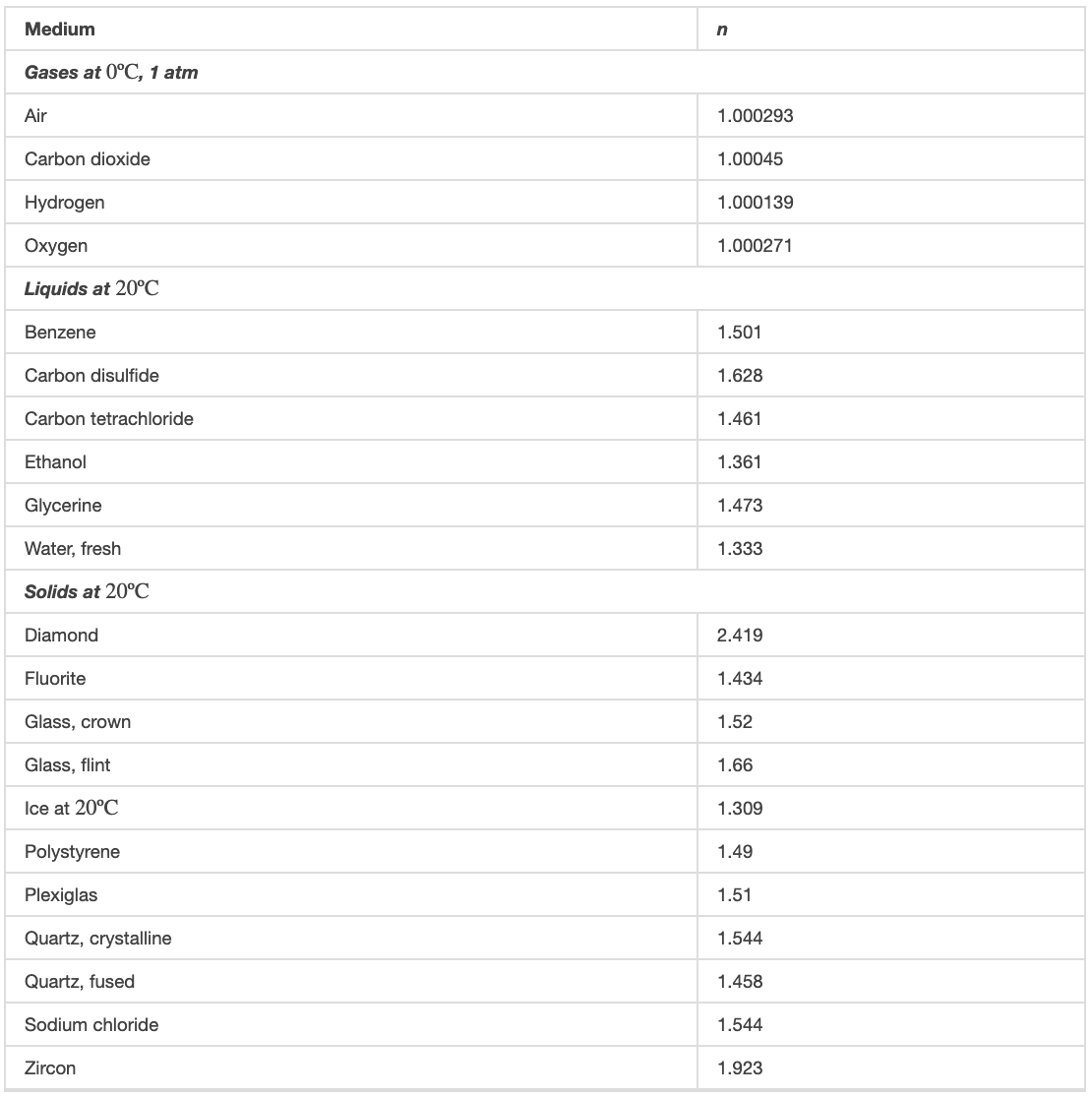
(a) Calculate the index of refraction for a medium in which the speed of light is 2.012 × 10⁸ m/s, and identify the most likely substance based on the information in the table.
(b) In what substance is the speed of light 2.290 × 10⁸ m/s?
Answer: (a) n = 1.49 (Polystyrene) (b) n = 1.31 (Ice at 20° C) (Click and drag over the answer to highlight it)
8.2
Suppose you have an unknown clear substance immersed in water, and you wish to identify it by finding its index of refraction. You arrange to have a beam of light enter it at an angle of 45.0º, and you observe the angle of refraction to be 40.3º. What is the index of refraction of the substance and its likely identity?
Answer: n = 1.457 (fused quartz)
8.3
Suppose the figure represents a ray of light going from air through crown glass into water, such as going into a fish tank. Calculate the amount the ray is displaced by the glass (Δ𝑥), given that the incident angle is 40.0º and the glass is 1.00 cm thick.
Answer: 3.73 mm
8.4
You can determine the index of refraction of a substance by determining its critical angle.
(a) What is the index of refraction of a substance that has a critical angle of 68.4º when submerged in water? What is the substance, based on the information in the table?
(b) What would the critical angle be for this substance in air?
Answer: (a) n = 1.434 (fluorite) (b) 44.2°
8.5
A light ray entering an optical fiber surrounded by air is first refracted and then reflected as shown in the figure. Show that if the fiber is made from crown glass, any incident ray will be totally internally reflected.
Answer:
8.6
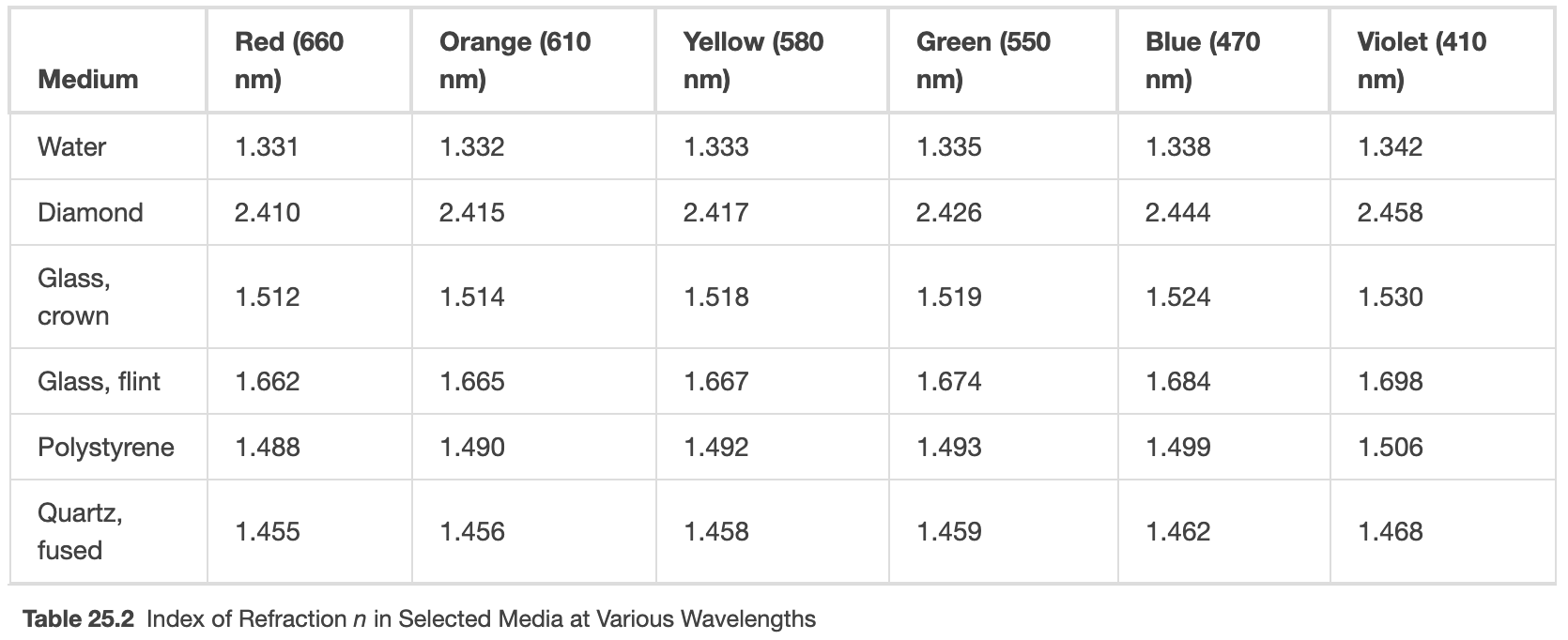
(a) What is the ratio of the speed of red light to violet light in diamond, based on the information in the table?
(b) What is this ratio in polystyrene?
(c) Which medium is more dispersive?
(d) A beam of white light goes from air into water at an incident angle of 75.0º. At what angles are the red and violet parts of the light refracted?
A dermatologist examines a mole with a 15.0-cm focal length magnifying glass held 13.5 cm from the mole.
(a) Where is the image located with respect to the magnifying glass?
(b) What is its magnification?
(c) How big is the image of a 5.00 mm diameter mole?
Answer: (a) 135 cm on the same side of the lens as the object (b) 10 (c) 5 cm
8.8
What magnification will be produced by a lens of power –4.00 D (such as might be used to correct myopia) if an object is held 25.0 cm away?
Answer: + 0.5
8.9
A shopper standing 3.00 m from a convex security mirror sees his image with a magnification of 0.250.
(a) Where is his image located with respect to the mirror?
(b) What is the focal length of the mirror?
(c) What is its radius of curvature?
Answer: (a) 0.75 m behind the mirror (b) -1 m (c) 2 m
8.10
An object 1.50 cm high is held 3.00 cm from a person’s cornea, and its reflected image is measured to be 0.167 cm high.
(a) What is the magnification?
(b) Where is the image with respect to the cornea?
(c) Find the radius of curvature of the convex mirror formed by the cornea. (Note that this technique is used by optometrists to measure the curvature of the cornea for contact lens fitting. The instrument used is called a keratometer, or curve measurer.)
Answer: (a) 0.1113 (b) 3.34 mm behind the cornea (c) 7.5 mm


 Physics Education Research at UNG