Potential Energy of a System

8.1 Potential Energy of a System
Learning Objectives
By the end of this section, you will be able to:
- Relate the difference of potential energy to work done on a particle for a system without friction or air drag
- Explain the meaning of the zero of the potential energy function for a system
- Calculate and apply the gravitational potential energy for an object near Earth’s surface and the elastic potential energy of a mass-spring system
Gravitational Potential Energy
The work done on an object by the constant gravitational force, near the surface of Earth, over any displacement is a function only of the difference in the positions of the end-points of the displacement.
You can justify this statement by answering the following question:
| Practice 8.1.1 |
|---|
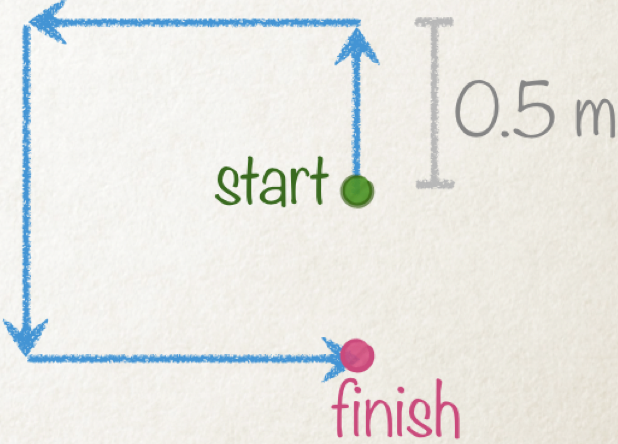 A 1-kg object is moved part-way around a square loop as shown. The square is 1 m on a side. The final position is 0.5 m lower than where it started. How much work has gravity done on the object during its journey? (Use g ≈ 10 m/s2) |
| (a) +5 J |
| (b) -5 J |
| (c) +10 J |
| (d) -10 J |
| (e) 0 J |
Again, consider the work done by the force of gravity in this problem. Use the work-energy theorem:  to answer the question.
| Practice 8.1.2 |
|---|
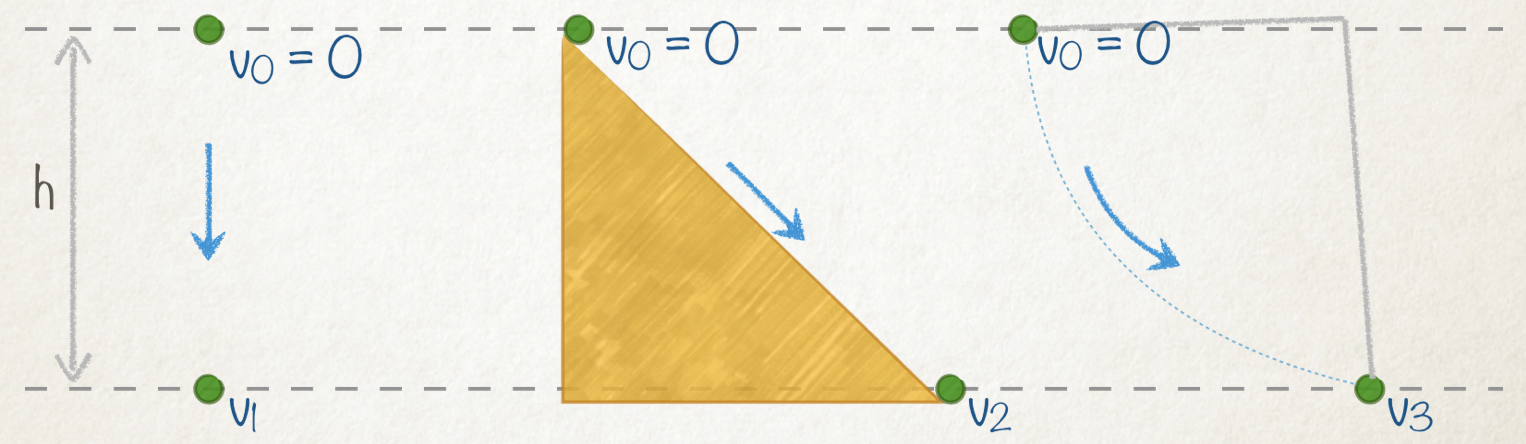 Three objects of mass m begin at height h with zero velocity. One falls straight down, one slides down a frictionless inclined plane, and one swings on the end of a pendulum. What is the relationship between their velocities when they have fallen to a final height of zero? |
| (a) v1 > v2 > v3 |
| (b) v1 > v3 > v2 |
| (c) v1 = v2 = v3 |

Discuss!
Consider how you would answer these questions. Then bring this to class for a group discussion.
A good, professional baseball pitcher throws a ball straight up in the air. Using the Work-Energy theorem, estimate how high the ball will go. (A good throw can reach 90 mph.)
The force of gravity is a special type of force called a conservative force. This is something we will discuss in the next section of the module. Without going into details about conservative forces just yet, I will give you a definition for potential energy:
The change in potential energy (U) of an object is equal to the negative of the work (Wcons) done by conservative forces.

 Physics Education Research at UNG