Transformers

11.6 Transformers
Learning Objectives
By the end of this section, you will be able to:
- Explain why power plants transmit electricity at high voltages and low currents and how they do this
- Develop relationships among current, voltage, and the number of windings in step-up and step-down transformers
Think about what you already know about power dissipation, resistance, and heat loss to answer this question:
| Practice 11.6.1 |
|---|
| To minimize heat losses for power transported across the country, it is best that current in the wires is… |
Transformers

Practice!
| Practice 11.6.2 |
|---|
 When the switch S is closed, the potential difference across R is: |
A.  |
B. 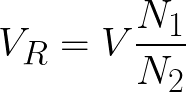 |
C.  |
D.  |
| Practice 11.6.3 |
|---|
The primary coil of a transformer is connected to a battery, a resistor, and a switch. The secondary coil is connected to an ammeter.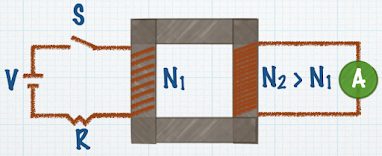 When the switch is thrown closed, the ammeter shows: |
| Practice 11.6.4 |
|---|
An ideal transformer is shown below. The voltage on the primary circuit is 10V. The primary circuit has 4 turns, the secondary circuit has 8 turns. What is the voltage on the secondary circuit? |
| Practice 11.6.5 |
|---|
| An ideal transformer is shown below. The current in the primary circuit is 10 mA. The primary circuit has 4 turns, the secondary circuit has 8 turns. What is the current in the secondary circuit. |
| Practice 11.6.6 |
|---|
| An ideal transformer (no power loss) is shown below. The primary circuit has 4 turns, the secondary circuit has 8 turns. What is the ratio of the power dissipated in the primary circuit and the power dissipated in the secondary circuit? |
 Physics Education Research at UNG