Equipotential Lines

Practice!
| Practice 3.4.1 |
|---|
 Which requires the most work, to move a positive charge from P to points 1, 2, 3 or 4 ? All points are the same distance from P. |
| Practice 3.4.2 |
|---|
Which requires zero work, to move a positive charge from P to points 1, 2, 3 or 4 ? All points are the same distance from P. |
| Practice 3.4.3 |
|---|
 Which two points have the same potential? |
| Practice 3.4.4 |
|---|
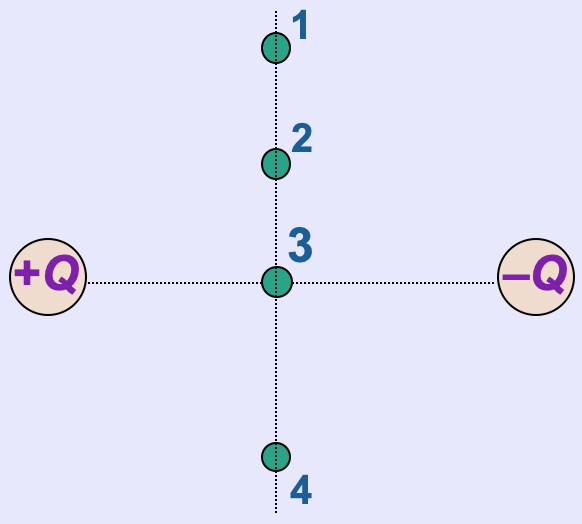 At which point does V = 0? |
| Practice 3.4.5 |
|---|
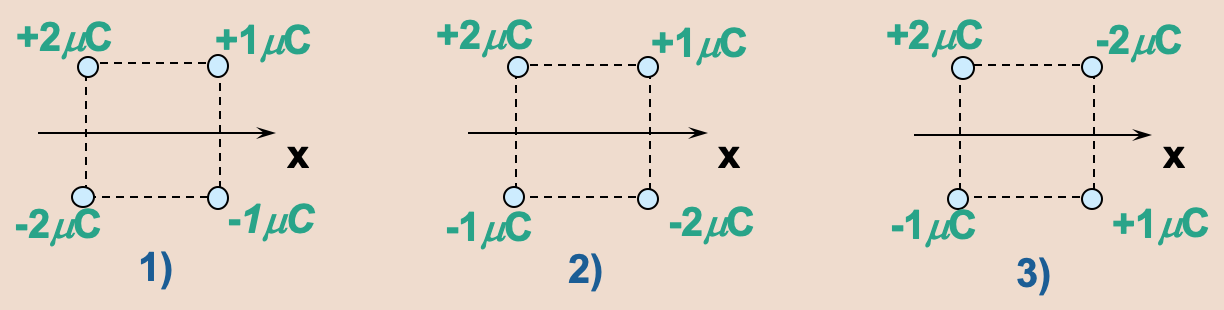 Which of these configurations gives V = 0 at all points on the x axis? |
| Practice 3.4.6 |
|---|
Which of these configurations gives V = 0 at all points on the y axis? |

Discuss!
The diagram below shows the location and charge of four identical small spheres. Find the electric potential at the five points indicated with open circles. Use these results and symmetry to find the potential at as many points as possible without additional calculation. Write your results on or near the points. Sketch at least 4 equipotential lines. Pick round values separated by a uniform interval. At least one of the lines should be disconnected.

 Physics Education Research at UNG