Model of Conduction in Metals

5.2 Model of Conduction in Metals
Learning Objectives
By the end of this section, you will be able to:
- Define the drift velocity of charges moving through a metal
- Define the vector current density
- Describe the operation of an incandescent lamp
Current Density

Practice!
| Practice 5.2.1 |
|---|
A copper cylinder is machined to have the following shape. The ends are connected to a battery so that a current flows through the copper.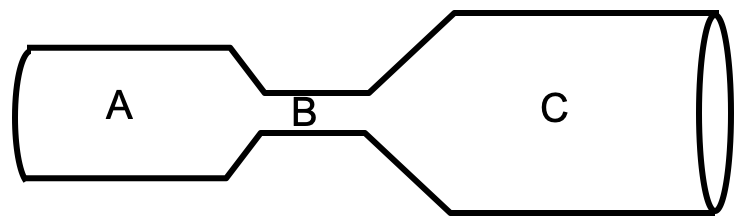 Which region has the greatest current density  ? ? |
| Practice 5.2.2 |
|---|
| A copper cylinder is machined to have the following shape. The ends are connected to a battery so that a current flows through the copper. Which region has the greatest magnitude of current, I? |
| Practice 5.2.3 |
|---|
| A copper cylinder is machined to have the following shape. The ends are connected to a battery so that a current flows through the copper. Which region has the greatest conductivity  ? ? |
| Practice 5.2.4 |
|---|
| A copper cylinder is machined to have the following shape. The ends are connected to a battery so that a current flows through the copper. Which region has the greatest magnitude electric field  ? ? |
| Practice 5.2.5 |
|---|
So far, we have concluded J is greatest in region B. (Using  , and , and  ) )The ratio of diameters is A:B:C = 3:1:5. How much larger magnitude is the drift velocity vd in region B compared to C? |

Discuss!
An 18-gauge copper wire (the size usually used for lamp cords), with a diameter of 1.02 mm, carries a constant current of 1.67 A to a 200-W lamp. The free-electron density in the wire is 8.5 x 1028 electrons per cubic meter. Suppose we replaced the wire with 12-gauge copper wire, which has twice the diameter of 18-gauge wire. If the current remains the same, what effect would this have on the magnitude of the drift velocity vd?
 Physics Education Research at UNG