Force and Torque on a Current Loop

7.5 Force and Torque on a Current Loop
Learning Objectives
By the end of this section, you will be able to:
- Evaluate the net force on a current loop in an external magnetic field
- Evaluate the net torque on a current loop in an external magnetic field
- Define the magnetic dipole moment of a current loop
Magnetic Force on a Current-Carrying Loop
Continuing the discussion about the magnetic force on a current carrying wire, we will now look at what happens if we take a wire and bend it into a loop. We’re going to bend the wire into the shape of a rectangle because it makes the math easier. Then we will put that loop in a uniform magnetic field.
Using the RHR, determine the direction of the magnetic force on each side of the loop.
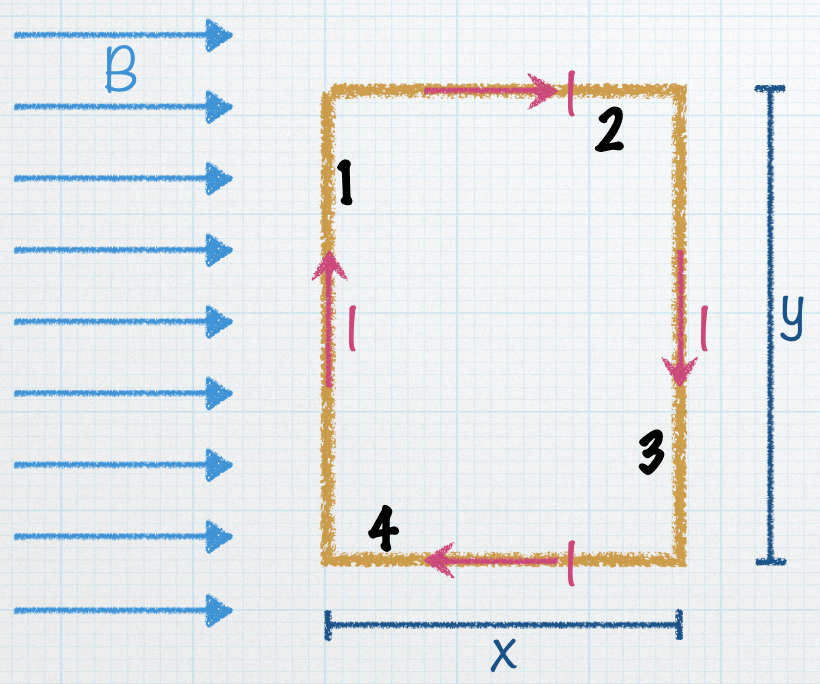
| Using the RHR, determine the direction of the magnetic force on each side of the loop. |
|---|
| What is the direction of the force on side 1 of the loop? |
| Using the RHR, determine the direction of the magnetic force on each side of the loop. |
|---|
| What is the direction of the force on side 2 of the loop? |
| Using the RHR, determine the direction of the magnetic force on each side of the loop. |
|---|
| What is the direction of the force on side 3 of the loop? |
| Using the RHR, determine the direction of the magnetic force on each side of the loop. |
|---|
| What is the direction of the force on side 4 of the loop? |
Torque
Here is a quick reminder of how to calculate torque.
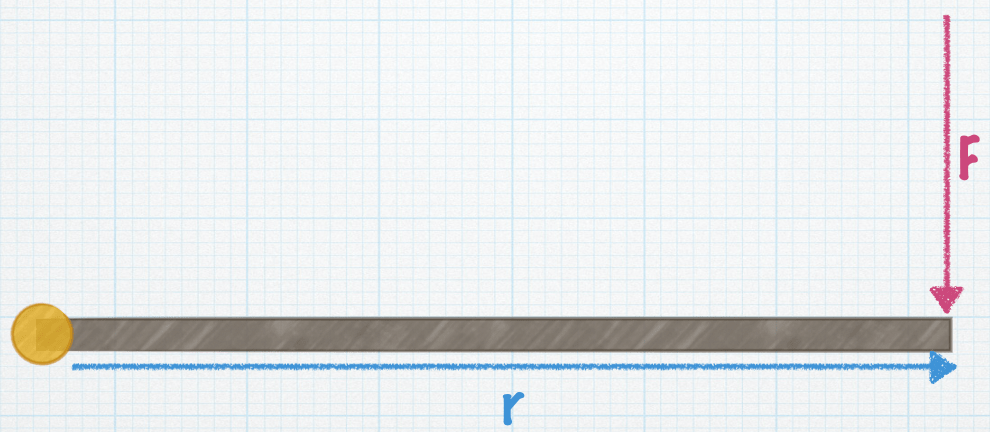
When a force (F) is applied to an object at some distance (r) away from a rotation point, then that object will rotate due to a torque. The torque is calculated with


where θ is the angle between r and F.

Practice!
See if you can use the RHR and your understanding of magnetic fields and forces to answer this:
| Practice 7.5.1 |
|---|
A rectangular loop carrying a current is placed in between two bar magnets. The direction of the current in the loop is denoted with an arrow. Looking at it from the side view, how will the loop move? |
Magnetic Dipole Moment

Discuss!
The south pole of a bar magnet is brought toward the current loop.
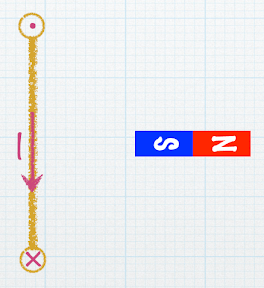
Does the bar magnet attract the loop, repel the loop, or have no effect on the loop?
 Physics Education Research at UNG