PHYS 3310 Module 10 Self Assessment Practice Problems
Module 10 Self Assessment Practice Problems
10.1
Potassium chloride (KCl) is a molecule formed by an ionic bond. At equilibrium separation the atoms are 𝑟0 = 0.279 nm apart.
(a) Determine the electrostatic potential energy of the atoms.
(b) The electron affinity of Cl is 3.89 eV and the ionization energy of K is 4.34 eV. Find the dissociation energy. (Neglect the energy of repulsion.)
(c) The measured energy dissociated energy of KCl is 4.43 eV. Determine the energy of repulsion of the ions due to the exclusion principle.
Answer: (a) -5.16 eV (b) 4.71 eV (c) 0.28 eV
10.2
The ionization energy of potassium is 4.34 eV; the electron affinity of iodine is 3.06 eV. At what separation distance will the KI molecule gain enough Coulomb energy to overcome the energy needed to form the K+ and I− ions?
Answer: 1.12 nm
10.3
(a) Calculate the electric potential energy for a K+ ion and a Br– ion separated by a distance of 0.29 nm, the equilibrium separation in the KBr molecule. Treat the ions as point charges.
(b) The ionization energy of the potassium atom is 4.3 eV. Atomic bromine has an electron affinity of 3.5 eV. Use these data and the results of part (a) to estimate the binding energy of the KBr molecule.
(c) Do you expect the actual binding energy to be higher or lower than your estimate? Explain your reasoning.
Answer: (a) -4.97 eV (b) 4.17 eV (c) lower
10.4
For the H2 molecule the equilibrium spacing of the two protons is 0.074 nm. The mass of a hydrogen atom is 1.67 x 10⁻²⁷ kg. Calculate the wavelength of the photon emitted in the rotational transition l = 2 to l = 1.
Answer: 41.3 µm
10.5
The rotation spectrum of the HCl molecule suggests a photon in the far infrared (around 5 x 10⁻⁶ m) can excite the first rotational level. From this data, determine the moment of inertia of the HCl molecule (in kg · m2).
Answer: 2.8 x 10-49 kg•m2
10.6
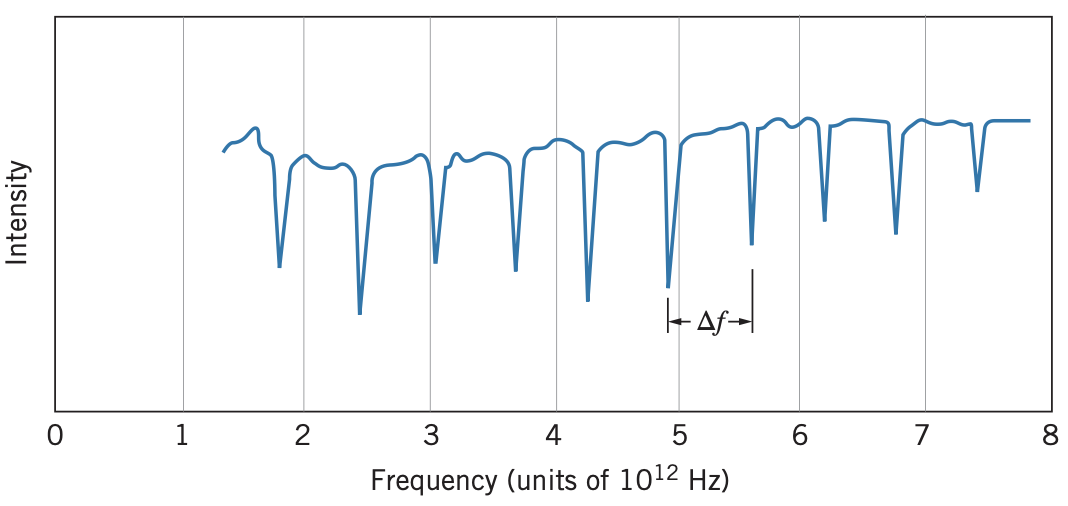
The figure shows a portion of the rotational absorption spectrum of a molecule. Determine the rotational inertia of the molecule.
Answer: 2.5 x 10-47 kg•m2
10.7
If a sodium chloride (NaCl) molecule could undergo an n to n – 1 vibrational transition with no change in rotational quantum number, a photon with wavelength 20.0 mm would be emitted. The mass of a sodium atom is 3.82 x 10⁻²⁶ kg, and the mass of a chlorine atom is 5.81 x 10⁻²⁶ kg. Calculate the force constant k for the interatomic force in NaCl.
Answer: 2 x 10⁻⁴ N/m
10.8
The average kinetic energy of an ideal-gas atom or molecule is 3/2 kBT , where T is the Kelvin temperature. The rotational inertia of the H2 molecule is 4.6 x 10-48 kg•m2. What is the value of T for which 3/2 kBT equals the energy separation between the l = 0 and l = 1 energy levels of H2? What does this tell you about the number of H2 molecules in the l = 1 level at room temperature?
Answer: 117 K
10.9
The vibrational transition in BeO is observed at a wavelength of 6.724 μm. What is the effective force constant of BeO?
Answer: 750 N/m
9.10
The vibrational energy of CO is 0.2691 eV when the constituents of the molecule are the most abundant isotopes of carbon (m = 12.00 u) and oxygen (m = 16.00 u).
(a) What would be the vibrational energy if the oxygen were replaced by the less abundant isotope with m = 18.00 u?
(b) What would be the vibrational energy if the carbon in the original CO were replaced with radioactive carbon (used in radiocarbon dating) with mass 14.00 u?
 Physics Education Research at UNG