PHYS 3310 Module 11 Self Assessment Practice Problems
Module 11 Self Assessment Practice Problems
11.1
An electron is confined to a metal cube of L = 0.8 cm on each side. Determine the density of states at
(a) E = 0.80 eV
(b) E = 2.2 eV
(c) E = 5.0 eV
Answer:
11.2
For free electrons in a solid, at what energy is the probability that a particular state is occupied equal to
(a) 0.01?
(b) 0.99?
Answer: (a) EF + 4.6kT (b) EF – 4.6kT
11.3
At low temperatures, copper has a free electron concentration of n = 8.45 x 1028 m-3. Using the free electron model, find the Fermi energy for solid copper, and find the speed of an electron with kinetic energy equal to the Fermi energy.
Answer: 7.03 eV, 1.57 x 10⁶ m/s
11.4
The table gives the occupation probabilities f(E) as a function of the energy E for a solid conductor at fixed temperature T. To determine the Fermi energy of the solid material, you are asked to analyze this information in terms of the Fermi–Dirac distribution.
(a) Graph the values in the table as E versus ln{[1/f(E)] – 1}. Find the slope and y-intercept of the best-fit straight line for the data points when they are plotted this way.
(b) Use your results of part (a) to calculate the temperature T and the Fermi energy of the material.
Answer:
11.5
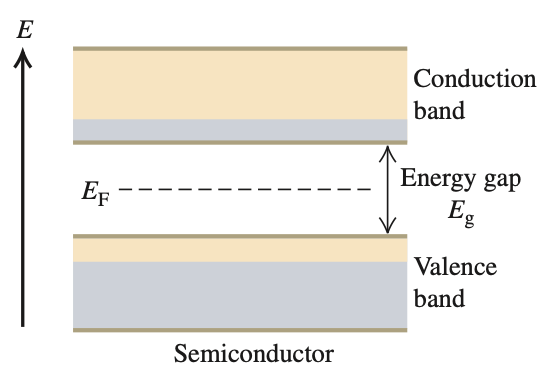
Consider a material with the band structure described above, with its Fermi energy in the middle of the gap. Find the probability that a state at the bottom of the conduction band is occupied at T = 300 K, and compare that with the probability at T = 310 K, for band gaps of:
(a) 0.200 eV
(b) 1.00 eV
(c) 5.00 eV
Answer: (a) 0.0205, 0.0231 (b) 4.0 x 10⁻⁹, 7.4 x 10⁻⁹ (c) 1.0 x 10-42, 2.3 x 10-41
11.6
The maximum wavelength of light that a certain silicon photocell can detect is 1.11 µm.
(a) What is the energy gap (in electron volts) between the valence and conduction bands for this photocell?
(b) Explain why pure silicon is opaque.
Answer:
11.7
The gap between valence and conduction bands in diamond is 5.47 eV.
(a) What is the maximum wavelength of a photon that can excite an electron from the top of the valence band into the conduction band? In what region of the electromagnetic spectrum does this photon lie?
(b) Explain why pure diamond is transparent and colorless.
(c) Most gem diamonds have a yellow color. Explain how impurities in the diamond can cause this color.
Answer:
11.8
A p-n diode has a reverse saturation current 1.44 × 10⁻⁸ A. It is forward biased so that it has a current of 6.78 × 10⁻¹ A moving through it. What bias voltage is being applied if the temperature is 300 K?
Answer: 𝑉𝑏 = 0.458 V
11.9
Applying the positive end of a battery to the p-side and the negative end to the n-side of a p-n junction, the measured current is 8.76 × 10⁻¹ A. Reversing this polarity give a reverse saturation current of 4.41 × 10⁻⁸ A. What is the temperature if the bias voltage is 1.2 V?
Answer: 𝑇 = 829 K
11.10
(a) A forward-bias voltage of 15.0 mV produces a positive current of 9.25 mA through a p–n junction at 300 K. What does the positive current become if the forward-bias voltage is reduced to 10.0 mV?
(b) For reverse-bias voltages of -15.0 mV and -10.0 mV, what is the reverse-bias negative current?

 Physics Education Research at UNG