Skip to content
Module 14 Self Assessment Practice Problems
| 14.1 |
|---|
| A positive pion at rest decays into a positive muon and a neutrino. |
| (a) Approximately how much energy is released in the decay? (Assume the neutrino has zero rest mass.) |
| (b) Why can’t a positive muon decay into a positive pion? |
| Answer: 33.9 MeV |
| 14.2 |
|---|
| A proton and an antiproton annihilate, producing two photons. Find the energy, frequency, and wavelength of each photon |
| (a) if the proton and antiproton are initially at rest |
| (b) if the proton and antiproton collide head-on, each with an initial kinetic energy of 620 MeV. |
| Answer: (a) 938.3 MeV, 2.27 x 10²³ Hz, 1.3 fm (b) `1558.3` MeV, 3.77 x 10²³ Hz, 0.8 fm |
| 14.3 |
|---|
Which of the following decays cannot occur because the law of conservation of lepton number is violated?
 |
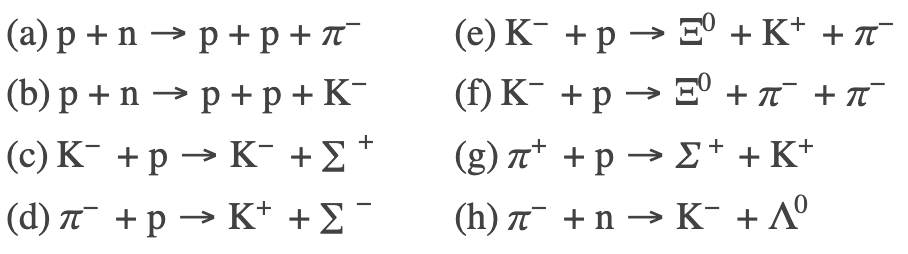
Which of the following reactions cannot because the law of conservation of strangeness is violated?
 |
| Answer: |
| 14.4 |
|---|
Which of the following reactions obey the conservation of baryon number?



 |
| Answer: |
| 14.5 |
|---|
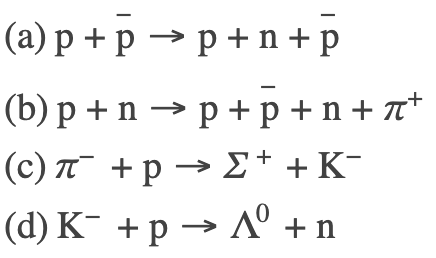
Each of the following strong nuclear reactions is forbidden. Identify a conservation law that is violated for each one.
 |
| Answer: |
 Physics Education Research at UNG