Doppler Effect for Light

2.1 Doppler Effect for Light
Learning Objectives
- Explain the origin of the shift in frequency and wavelength of the observed wavelength when the observer and source move toward or away from each other
- Derive an expression for the relativistic Doppler shift
- Apply the Doppler shift equations to real-world examples
Red Shift
The observed wavelength 𝜆obs of electromagnetic radiation is longer (called a “red shift”) than that emitted by the source when the source moves away from the observer or when the observer moves away from the source.

Blue Shift
The observed wavelength 𝜆obs of electromagnetic radiation is shorter (called a “blue shift”) than that emitted by the source when the source moves toward the observer or the observer moves toward the source.


Practice!
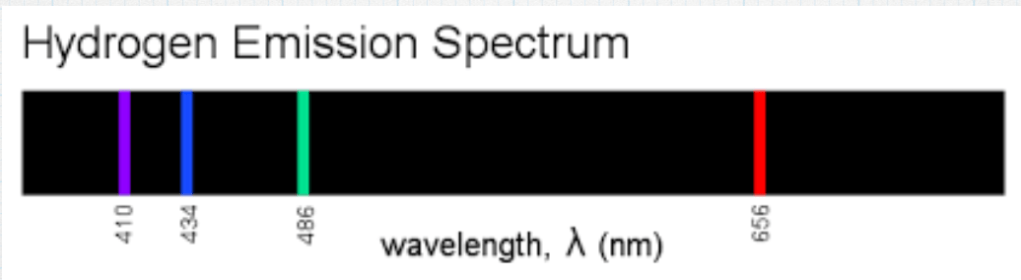
Suppose that you’d like to find out how a distant star is moving relative to Earth. The star is much too far away to detect any change in its brightness as it moves toward or away from Earth. Instead we can use the Doppler effect to determine its relative speed. For this problem we are going to look at the spectral lines from hydrogen, specifically the one with a wavelength of 656.46 nm.
| Practice 2.1.1 |
|---|
| Suppose that you measure the light of a star between 640 and 680 nm and you get a very strong peak around 650 nm. What can you say about the star’s motion? |
| A. It is moving away from Earth. |
| B. It is moving toward Earth. |
| C. It is not moving relative to Earth. |
| D. It is moving tangent to the direction of Earth. |
| Practice 2.1.2 |
|---|
| What is vstar, the speed at which the star is moving relative to the earth? |
| A. 0.00989c |
| B. 0.00495c |
| C. 0.00247c |
| D. 0.0198c |
| Practice 2.1.3 |
|---|
| Suppose that you measured a peak at 680 nm instead. What is the relative speed vstar of the star to the earth in this case? |
| A. 0.014c |
| B. 0.070c |
| C. 0.088c |
| D. 0.035c |

Discuss!
How fast and in what direction must galaxy A be moving if an absorption line found at wavelength 550 nm (green) for a stationary galaxy is shifted to 450 nm (blue) (a “blue-shift”) for galaxy A?
Check your answer: v = 0.2c
Calculate, for the judge, how fast were you going when you ran the red light because it appeared Doppler-shifted green to you. (Wavelengths: Red: 650nm, Green: 550nm)
Check your answer: 0.164c
All galaxies farther away than about 50 × 106 ly exhibit a red shift in their emitted light that is proportional to distance, with those farther and farther away having progressively greater red shifts. What does this imply, assuming that the only source of red shift is relative motion?
 Physics Education Research at UNG