Explain how the work-energy theorem leads to an expression for the relativistic kinetic energy of an object
Show how the relativistic energy relates to the classical kinetic energy, and sets a limit on the speed of any object with mass
Describe how the total energy of a particle is related to its mass and velocity
Explain how relativity relates to energy-mass equivalence, and some of the practical implications of energy-mass equivalence
Kinetic Energy and the Ultimate Speed Limit
Relativistic kinetic energy of a particle with mass m is
No object with mass can attain the speed of light.
Practice!
Practice 2.3.1
What is the rest energy of an electron?
A. 8.19 MeV
B. 511 MeV
C. 0.409 MeV
D. 0.511 MeV
Check your answer: D. 0.511 MeV
Practice 2.3.2
If the rest of energy of one electron is used to accelerate a second electron, how fast will the second electron be moving?
A. 0.987c
B. 0.215c
C. 0.866c
D. 0.433c
Check your answer: C. 0.866c
Total Relativistic Energy
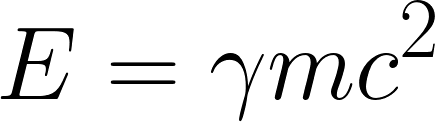
The total energy E of a particle is
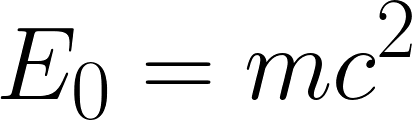
The rest energy of a particle is
Practice!
Practice 2.3.3
If the total energy of a proton is three times its rest energy, what is the speed of the proton?
A. 0.94c
B. 0.46c
C. 0.75c
D. 0.99c
Check your answer: A. 0.94c
Practice 2.3.4
If the total energy of a proton is three times its rest energy, what is the kinetic energy of the proton?
A. 664 MeV
B. 415 MeV
C. 1876 MeV
D. 963 MeV
Check your answer: C. 1876 MeV
Relativistic Energy and Momentum
Practice!
Practice 2.3.5
If the total energy of a proton is three times its rest energy, what is the momentum of the proton?
A. 2814 MeV/c
B. 2653 MeV/c
C. 1625 MeV/c
D. 812 MeV/c
Check your answer: B. 2653 MeV/c
Practice 2.3.6
The following three particles all have the same total energy E: (a) a photon (b) a proton (c) an electron Rank the magnitudes of the particles’ momentum from smallest to greatest.
A. (b) < (a) < (c)
B. (c) < (b) < (a)
C. (b) < (c) < (a)
D. (a) < (c) < (b)
Check your answer: C. (b) < (c) < (a)
Mass-Energy Equivalence
The file below contains a table of atomic masses for the elements and their most abundant isotopes.
How does the mass of a hydrogen atom compare to the mass of a proton plus the mass of an electron?
A. It is the same: mH = me + mp
B. It is less: mH < me + mp
C. It is greater: mH > me + mp
Check your answer: B. It is less: mH < me + mp
Practice 2.3.8
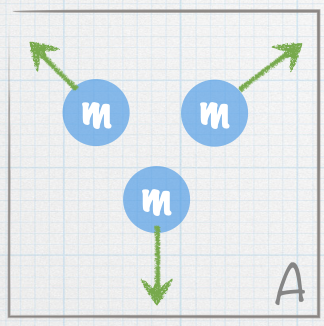
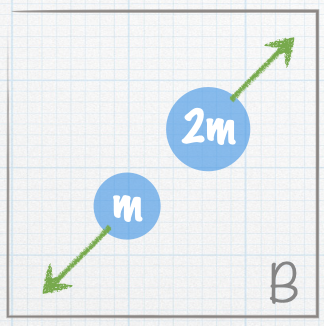
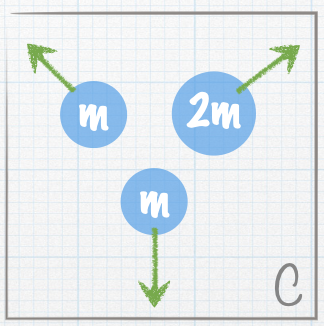
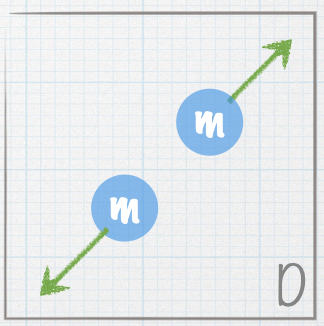
A stationary nucleus of mass 3m decays into smaller nuclei. The masses of the smaller nuclei are given in the figures. The green arrows represent the velocities of the smaller nuclei. Which of the following represents a possible final state?
E. Both A and B
Check your answer: D
Discuss!
It is known that two oxygen atoms attract one another and can unite to form an O2 molecule, with the release of energy Eout ≈ 5 eV (in the form of light if the reaction takes place in isolation). By how much is the O2 molecule lighter than the two O atoms (in units of kg)?




 Physics Education Research at UNG