Module 4 Self Assessment Practice Problems
| 4.1 |
|---|
| A hydrogen atom can absorb a photon only if the photon’s energy matches exactly the energy difference between two allowed states — with one exception: if the photon has enough energy to free the electron from the atom entirely, the atom is ionized and the excess energy becomes kinetic energy of the freed electron. |
| (a) When a hydrogen atom is in its ground state (n = 1), what are the shortest and longest wavelengths of photons it can absorb without ionizing the atom? |
| (b) When a hydrogen atom is in its third excited state (n = 4), what are the shortest and longest wavelengths of photons it can emit? |
| (c) What is the longest wavelength a photon can have and still be energetic enough to ionize a hydrogen atom in its ground state? |
| Answer: (a) 91 nm, 121.6 nm (b) 97.3 nm, 1879 nm (c) 91 nm |
| 4.2 |
|---|
| An emission line in the infrared spectrum of atomic hydrogen has a wavelength of 4.653 μm. This line corresponds to a transition in which an electron falls from an unknown initial state ni to a final state of nf = 5. What is the initial quantum number ni? |
| Answer: 7 |
| 4.3 |
|---|
| In the Bohr model of hydrogen, an electron in a given energy level has well-defined values of angular momentum, kinetic energy, potential energy, and total energy. For an electron in the n = 2 state, calculate: |
| (a) the angular momentum |
| (b) the kinetic energy |
| (c) the potential energy |
| (d) the total energy |
| Notice the relationship between your answers to (b) and (c). Does this ratio hold for other values of n? |
| Answer: (a) 1.316 x 10⁻¹⁵ eV•s (b) 3.4 eV (c) -6.8 eV (d) -3.4 eV |
| 4.4 |
|---|
 One of the most striking demonstrations of wave-particle duality came in 1991, when physicists passed a beam of helium atoms through a double slit and observed an interference pattern on the other side — the same pattern you would expect from light waves, but produced by whole atoms. The beam of helium atoms had a kinetic energy of 0.020 eV. |
| (a) Using the de Broglie relation, calculate the wavelength of a helium atom with this kinetic energy. |
| (b) The figure shows the interference pattern recorded in the experiment. The double slit is separated by 8 μm, and the detector is 64 cm from the slits. Estimate the fringe spacing from the figure and use it to calculate the de Broglie wavelength of the helium atoms. How does your estimate compare to your answer in part (a)? |
| Answer: (a) 1.02 Å (b) 1 Å |
| 4.5 |
|---|
Neutrons produced in a nuclear reactor are slowed down through repeated collisions until their kinetic energy matches the thermal energy of the surrounding material. These are called thermal neutrons, and their kinetic energy is given by: 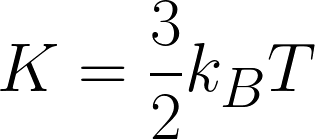 where kB is the Boltzmann constant and T is room temperature (293 K). |
| (a) What is the kinetic energy of a thermal neutron at room temperature? |
| (b) What is the de Broglie wavelength of a thermal neutron? Your answer to (b) should be on the order of the spacing between atoms in a solid crystal — which is exactly why neutron diffraction is a powerful tool for studying crystal structures, complementing the X-ray diffraction technique you used in lab. |
| Answer: (a) 0.038 eV (b) 0.146 nm |
| 4.6 |
|---|
| An electron microscope uses a beam of electrons rather than visible light to image very small objects. Like any wave-based imaging system, it can only resolve features that are comparable in size to the wavelength of the probe — in this case, the de Broglie wavelength of the electrons. A shorter wavelength requires a higher accelerating voltage. Through what potential difference must electrons be accelerated so that their de Broglie wavelength is small enough to resolve each of the following objects? |
| (a) a virus of diameter 15 nm |
| (b) an atom of diameter 0.096 nm |
| (c) a proton of diameter 1.2 fm |
| What does your answer to (c) tell you about the feasibility of using electron microscopy to image individual protons? |
| Answer: (a) 0.0067 V (b) 163 V (c) 1 x 10¹² V |
| 4.7 |
|---|
| The Heisenberg uncertainty principle sets a fundamental limit on how precisely position and momentum can both be known simultaneously. This has a striking practical consequence: if you measure an electron’s speed very precisely, you cannot know where it is very precisely — and vice versa. The speed of an electron is measured with an uncertainty of 2.8 × 10⁴ m/s. What is the minimum size of the region of space in which this electron could be confined, consistent with the uncertainty principle? |
| Answer: 2.1 nm |
| 4.8 |
|---|
| The radius of a typical atomic nucleus is approximately 5.0 × 10⁻¹⁵ m. The uncertainty principle places a fundamental constraint on the momentum of any particle confined to such a small region — and the consequences are dramatic. |
| (a) Estimate the minimum uncertainty in the momentum of a proton confined within a nucleus. |
| (b) Since the proton is confined to the nucleus, its momentum cannot be zero — the uncertainty in momentum gives a lower bound on the magnitude of the momentum itself. Using this estimate of the momentum magnitude and the relativistic energy-momentum relation E2 = (mc2)2 + (pc)2, estimate the kinetic energy of a proton confined within a nucleus. |
| (c) For a proton to remain bound within the nucleus rather than flying out, the potential energy holding it in must be at least as large in magnitude as the kinetic energy trying to push it out. Estimate the minimum magnitude of this binding potential energy. Compare it to the potential energy of an electron in a hydrogen atom, which is on the order of tens of eV. |
| What does this comparison tell you about the nature of the force that holds the nucleus together — and why it cannot be the electromagnetic force? |
| Answer: (a) 19.7 MeV/c (b) 200 keV (c) -200 keV |
| 4.9 |
|---|
 A pion (π meson) and a proton can briefly combine to form an unstable particle called the Δ particle. Because the Δ exists for only an extremely short time before decaying, the energy-time form of the uncertainty principle tells us that its rest energy cannot be perfectly defined — it has an inherent spread. The figure shows the measured energy of the π-p system as a function of energy. The peak at 1236 MeV corresponds to the rest energy of the Δ particle, and the width of the peak — the experimental energy spread — is approximately 120 MeV. Using the energy-time uncertainty relation, estimate the lifetime of the Δ particle. |
| Answer: 2.7 x 10⁻²⁴ s |
| 4.10 |
|---|
| In 1935, the Japanese physicist Hideki Yukawa proposed that the strong nuclear force is carried by a previously unknown particle — what we now call the pion (π meson). He predicted its mass using a remarkable argument: the uncertainty principle allows a proton to briefly “borrow” enough energy to create a pion, as long as the pion is reabsorbed quickly enough that the energy violation is hidden within the uncertainty ΔE⋅Δt ≥ ℏ/2. The range of the strong force, he argued, is determined by how far the pion can travel in the time allowed. The pion was discovered experimentally in 1947, with a mass close to Yukawa’s prediction. In this problem you will reconstruct Yukawa’s argument. |
| (a) A proton briefly emits a pion: p → p + π. By how much ΔE does this process appear to violate conservation of energy? The pion has a rest mass energy of 135 MeV. Ignore any kinetic energies. |
| (b) The uncertainty principle permits this energy violation, provided the pion is reabsorbed within a time Δt satisfying ΔE⋅Δt ≈ ℏ/2. How long can the pion exist? |
| (c) Assuming the pion travels at very nearly the speed of light, how far from the proton can it travel before it must be reabsorbed? This distance is an estimate of the range of the strong nuclear force. How does it compare to the size of a nucleus? |
| Answer: (a) 135 MeV (b) 2.4 x 10⁻²⁴ s (c) 0.72 fm |

