Wave Functions

5.1 Wave Functions
Learning Objectives
- Describe the statistical interpretation of the wave function
- Use the wave function to determine probabilities
- Calculate expectation values of position, momentum, and kinetic energy
Probability Density
Probability to find a particle in a small interval (x, x + dx)


Practice!
| Practice 5.1.1 |
|---|
Which of the following hypothetical wave functions for a particle in some realistic potential U(x) is acceptable? |
| A. (a) |
| B. (b) |
| C. (c) |
| D. more than one |
| E. none of them |
| Practice 5.1.2 |
|---|
Which of the following wavefunctions corresponds to a particle more likely to be found on the left side? |
| A. (a) |
| B. (b) |
| C. (c) |
| D. more than one |
| E. none of them |
Normalizing the Wave Function
Normalization Condition
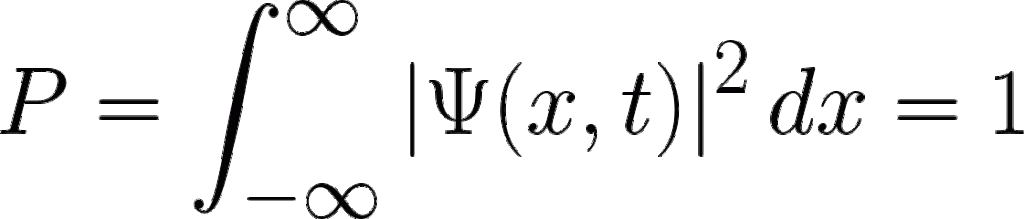

Discuss!
What is A when the wave function 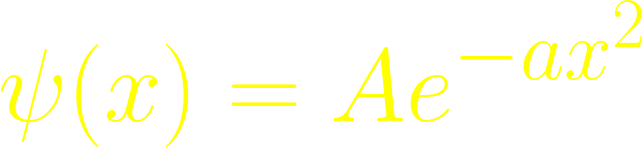 is normalized?

Complex Conjugate
Discuss!
If 𝑎 = 3 + 4𝑖, what is the product 𝑎∗𝑎?
Suppose that a particle with energy E is moving along the x-axis and is confined in the region between 0 and L. One possible wave function is

Determine the normalization constant.
Expectation Value
Expectation Value of Position

Expectation Value of Momentum

Expectation Value of Kinetic Energy

 Physics Education Research at UNG