(a) For what values of x is there the highest probability of finding the particle described by this wave function? Explain.
(b) For which values of x is the probability zero? Explain.
Answer: (a) π/2k, 3π/2k (b) 0, π/k, 2π/k
5.4
Compute for where is time-independent and is a real constant. Is this a wave function for a stationary state? Why or why not?
Answer: (a) |Ψ|2 = |𝜓|2 sin2𝜔𝑡 (b) No
5.5
A 10.0-g marble is gently placed on a horizontal tabletop that is 1.75 m wide.
(a) What is the maximum uncertainty in the horizontal position of the marble?
(b) According to the Heisenberg uncertainty principle, what is the minimum uncertainty in the horizontal velocity of the marble?
(c) In light of your answer to part (b), what is the longest time the marble could remain on the table? Compare this time to the age of the universe, which is approximately 14 billion years. (Hint: Can you know that the horizontal velocity of the marble is exactly zero?)
Answer: (a) 1.75 m (b) 3 x 10-33 m/s (c) 1.8 x 1025 years
5.6
A scientist has devised a new method of isolating individual particles. He claims that this method enables him to detect simultaneously the position of a particle along an axis with a standard deviation of 0.12 nm and its momentum component along this axis with a standard deviation of 3.0 x 10⁻²⁵ kg•m/s. Use the Heisenberg uncertainty principle to evaluate the validity of this claim.
Answer:
5.7
Show that is a valid solution to Schrӧdinger’s time-dependent equation.
Answer:
5.8
Show that Ψ(𝑥,𝑡) = 𝐴 sin(𝑘𝑥−𝜔𝑡) and Ψ(𝑥,𝑡) = 𝐴 cos(𝑘𝑥−𝜔𝑡) do not obey Schrӧdinger’s time-dependent equation.
Answer:
5.9
A particle with mass m is described by the following wave function: 𝜓(𝑥) = 𝐴 cos(𝑘𝑥) + 𝐵 sin(𝑘𝑥), where A, B, and k are constants. Assuming that the particle is free, show that this function is the solution of the stationary Schrӧdinger equation for this particle and find the energy that the particle has in this state.
Answer: E = p2/2m
5.10
A free proton has a wave function given by . The coefficient of x is in inverse meters (m−1) and the coefficient of t is in inverse seconds (s−1). Find its momentum and energy.
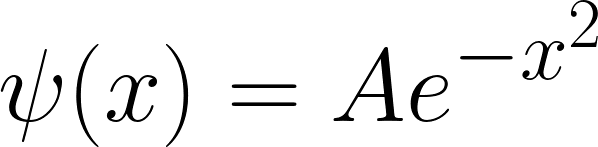


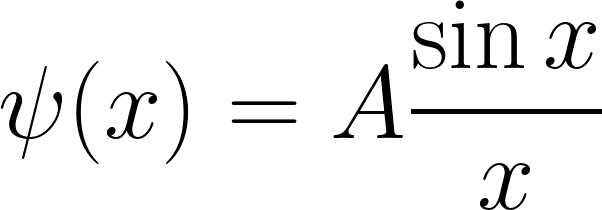
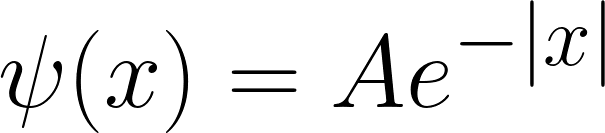

 .
.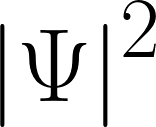 for
for  where
where  is time-independent and
  is a real constant. Is this a wave function for a stationary state? Why or why not?
 is a valid solution to Schrӧdinger’s time-dependent equation.
 . The coefficient of x is in inverse meters (m−1) and the coefficient of t is in inverse seconds (s−1). Find its momentum and energy.
 Physics Education Research at UNG