(a) For what values of x is there the highest probability of finding the particle described by this wave function? Explain.
(b) For which values of x is the probability zero? Explain.
Answer: (a) π/2k, 3π/2k (b) 0, π/k, 2π/k
5.4
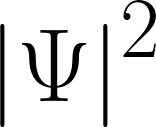
Compute for where is time-independent and is a real constant. Is this a wave function for a stationary state? Why or why not?
Answer: (a) |Ψ|2 = |𝜓|2 sin2𝜔𝑡 (b) No
5.5
One of the strangest consequences of the Heisenberg uncertainty principle is that truly macroscopic objects — ones you can hold in your hand — are also subject to quantum uncertainty. The effects are just so fantastically small that they are completely undetectable in practice.
A 10.0-g marble is gently placed at rest on a horizontal tabletop that is 1.75 m wide.
(a) What is the maximum uncertainty in the horizontal position of the marble?
(b) The marble appears to be at rest — but according to the uncertainty principle, can its horizontal velocity be exactly zero? What is the minimum uncertainty in its horizontal velocity?
(c) If the marble has even the tiniest non-zero horizontal velocity, it will eventually reach the edge of the table and fall off. Using your answer to part (b) as an estimate of that velocity, calculate the longest time the marble could remain on the table. Compare this to the age of the universe, which is approximately 14 billion years.
What does this result tell you about why quantum effects are unobservable in everyday life?
Answer: (a) 1.75 m (b) 3 x 10-33 m/s (c) 1.8 x 1025 years
5.6
A scientist claims to have developed a new technique for isolating individual particles. According to the claim, the method can simultaneously measure the position of a particle along an axis with a standard deviation of 0.12 nm and its momentum along the same axis with a standard deviation of 3.0 × 10⁻²⁵ kg•m/s.
Use the Heisenberg uncertainty principle to evaluate whether this claim is physically possible. Is the scientist’s claim consistent with the laws of quantum mechanics? What is the minimum product Δx⋅Δp that the uncertainty principle permits, and how does it compare to what the scientist is claiming?
Answer:
5.7
Show that is a valid solution to Schrӧdinger’s time-dependent equation.
Answer:
5.8
Show that Ψ(𝑥,𝑡) = 𝐴 sin(𝑘𝑥−𝜔𝑡) and Ψ(𝑥,𝑡) = 𝐴 cos(𝑘𝑥−𝜔𝑡) do not obey Schrӧdinger’s time-dependent equation.
Answer:
5.9
A particle with mass m is described by the following wave function: 𝜓(𝑥) = 𝐴 cos(𝑘𝑥) + 𝐵 sin(𝑘𝑥), where A, B, and k are constants. Assuming that the particle is free, show that this function is the solution of the stationary Schrӧdinger equation for this particle and find the energy that the particle has in this state.
Answer: E = p2/2m
5.10
A free proton has a wave function given by . The coefficient of x is in inverse meters (m−1) and the coefficient of t is in inverse seconds (s−1). Find the proton’s momentum and energy. Are these values consistent with what you would expect for a non-relativistic proton?



 .
. for
for  where
where  is time-independent and
  is a real constant. Is this a wave function for a stationary state? Why or why not?
 is a valid solution to Schrӧdinger’s time-dependent equation.
 . The coefficient of x is in inverse meters (m−1) and the coefficient of t is in inverse seconds (s−1). Find the proton’s momentum and energy. Are these values consistent with what you would expect for a non-relativistic proton?
