The Quantum Tunneling of Particles through Potential Barriers

6.3 The Quantum Tunneling of Particles through Potential Barriers
Learning Objectives
- Describe how a quantum particle may tunnel across a potential barrier
- Identify important physical parameters that affect the tunneling probability
- Identify the physical phenomena where quantum tunneling is observed
- Explain how quantum tunneling is utilized in modern technologies
Finite Potential Well

Discuss!
Consider two square wells of the same width, one with finite walls and the other with infinite walls. Compare the energy and momentum of a particle trapped in the finite well with the energy and momentum of an identical particle in the infinite well.
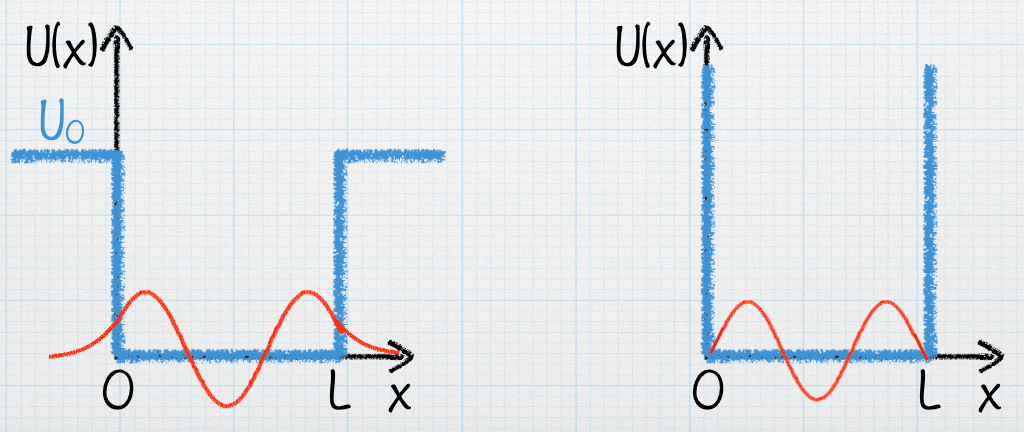
Potential Barrier Penetration
Quantum Tunneling

Practice!
| Practice 6.3.1 |
|---|
| Consider a particle tunneling through a barrier. Which of the following will increase the likelihood of tunneling? |
| A. decrease the height of the barrier |
| B. decrease the width of the barrier |
| C. decrease the mass of the particle |
| D. All of the above |
| Practice 6.3.2 |
|---|
| Consider a particle tunneling through a barrier. What is the energy of the particles that have successfully “escaped”? |
| A. < initial energy |
| B. = initial energy |
| C. > initial energy |
| D. zero |
| Practice 6.3.3 |
|---|
| We just looked at Polonium, with an effective barrier width of ~10 fermi, and saw a tunneling probability of ~10-15. Now consider Uranium, which has a similar barrier height, but an effective width of about ~20 fermi. Estimate the tunneling probability in Uranium: |
| A. ~10-30 |
| B. ~10-14 |
| C. ~10-7 |
Discuss!
You’re putting the electrical wiring in your new house, and you’re considering using Aluminum wiring, which is cheap and a good conductor. However, you also know that aluminum tends to form an oxide surface layer (Al2O3) which can be as much as several nanometers thick.
This layer could cause a problem in making electrical contacts with outlets, for example, since it presents a barrier of roughly 10 eV to the flow of electrons in and out of the Al.
Your requirement is that the transmission probability across any contact must be T > 10-10, or else the resistance will be too high for the high currents you’re using, causing a fire risk. Should you use aluminum wiring or not?
 Physics Education Research at UNG