PHYS 3310 Module 7 Self Assessment Practice Problems
Module 7 Self Assessment Practice Problems
7.1
(a) Find the value of the constant C that normalizes the wave function
(b) Find the probability that the particle will be found somewhere in the region for the cases (i) (nx,ny,nz) = (1,2,1), (ii) (nx,ny,nz) = (2,1,1), and (iii) (nx,ny,nz) = (3,1,1)
Answer: (a) C = (2/L)3/2 (b) 0.091, 0.250, 0.303
7.2
Model a hydrogen atom as an electron in a cubical box with side length L. Set the value of L so that the volume of the box equals the volume of a sphere of radius a = 5.29 x 10⁻¹¹ m, the Bohr radius. Calculate the energy separation between the ground and first excited levels, and compare the result to this energy separation calculated from the Bohr model.
Answer: 154.6 eV
7.3
A photon is emitted when an electron in a three-dimensional cubical box of side length 8.00 x 10⁻¹¹ m makes a transition from the nX= 2, nY= 2, nZ= 1 state to the nX= 1, nY= 1, nZ= 1 state. What is the wavelength of this photon?
Answer: 3.53 nm
7.4
Coulomb’s force law states that the force between two charged particles is: 𝐹 = 𝑘𝑄𝑞/𝑟2. Use this expression to determine the potential energy function.
Answer: U = -ke2/r
7.5
A hydrogen atom is in a state that has . In the semiclassical vector model, the angular momentum vector for this state makes an angle of 63.4° with the +z-axis.
(a) What is the l quantum number for this state?
(b) What is the smallest possible n quantum number for this state?
Answer: (a) 4 (b) 5
7.6
Consider hydrogen in the ground state, 𝜓100.
(a) Use the derivative to determine the radial position for which the probability density, P(r), is a maximum.
(b) Use the integral concept to determine the average radial position. (This is called the expectation value of the electron’s radial position.) Express your answers into terms of the Bohr radius, 𝑎𝑜. Hint: The expectation value is the just average value.
(c) Why are these values different?
Answer: (a) a0 (b) (3/2)a0
7.7
What is the probability that the 1s electron of a hydrogen atom is found outside the Bohr radius?
Answer: 0.68
7.8
Find the minimum torque magnitude 𝜏⃗ that acts on the orbital magnetic dipole of a 3p electron in an external magnetic field of 2.50 × 10⁻³ T.
Answer: 3.28 x 10⁻²⁶ N•m
7.9
A hydrogen atom in a 3p state is placed in a uniform external magnetic field B. Consider the interaction of the magnetic field with the atom’s orbital magnetic dipole moment.
(a) What field magnitude B is required to split the 3p state into multiple levels with an energy difference of 2.71 x 10⁻⁵ eV between adjacent levels?
(b) How many levels will there be?
Answer: (a) 0.469 T (b) 3
7.10
A hydrogen atom in the 5g state is placed in a magnetic field of 0.600 T that is in the z-direction.
(a) Into how many levels is this state split by the interaction of the atom’s orbital magnetic dipole moment with the magnetic field?
(b) What is the energy separation between adjacent levels?
(c) What is the energy separation between the level of lowest energy and the level of highest energy?
Answer: (a) 9 (b) 3.47 x 10⁻⁵ eV (c) 2.77 x 10⁻⁴ eV


 for the cases (i) (nx,ny,nz) = (1,2,1), (ii) (nx,ny,nz) = (2,1,1), and (iii) (nx,ny,nz) = (3,1,1)
 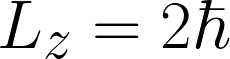 . In the semiclassical vector model, the angular momentum vector
  for this state makes an angle of 63.4° with the +z-axis.
 Physics Education Research at UNG