PHYS 3310 Module 8 Self Assessment Practice Problems
Module 8 Self Assessment Practice Problems
8.1
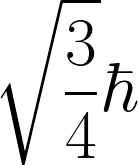
(a) If you treat an electron as a classical spherical object with radius 1.0 x 10⁻¹⁷ m, what angular speed is necessary to produce a spin angular momentum of magnitude ?
(b) Use and the result of part (a) to calculate the speed of a point at the electron’s equator. What does your result suggest about the validity of this model?
Answer: (a) 2.5 x 1030 rad/s (b) 2.5 x 10¹³ m/s
8.2
A hydrogen atom is placed in an external uniform magnetic field (B = 200 T). Calculate the wavelength of light produced in a transition from a spin up to spin down state.
Answer: 53.5 µm
8.3
The hyperfine interaction in a hydrogen atom between the magnetic dipole moment of the proton and the spin magnetic dipole moment of the electron splits the ground level into two levels separated by 5.9 x 10⁻⁶ eV.
(a) Calculate the wavelength and frequency of the photon emitted when the atom makes a transition between these states. In what part of the electromagnetic spectrum does this lie? Such photons are emitted by cold hydrogen clouds in interstellar space; by detecting these photons, astronomers can learn about the number and density of such clouds.
(b) Calculate the effective magnetic field experienced by the electron in these states.
Answer: (a) 21 cm (b) 0.051 T
8.4
While working in a magnetics lab, you conduct an experiment in which a hydrogen atom in the n = 1 state is in a magnetic field of magnitude B. A photon of wavelength (in air) is absorbed in a transition from the ms = -1/2 to the ms = +1/2 state. The wavelengths as a function of B are given in the table.
(a) Graph the data in the table as photon frequency f versus B, where f = c/. Find the slope of the straight line that gives the best fit to the data.
(b) Use the results of part (a) to calculate |µz|, the magnitude of the spin magnetic moment.
(c) Let = |µz|/|Sz| denote the gyromagnetic ratio for electron spin. Use your result from part (b) to calculate . What is the value of /(e/2m) given by the experimental data?
Answer: (a) 2.84 x 10¹⁰ T•s (b) 5.88 x 10⁻⁵ eV/T (c) 2.03
8.5
An electron in a hydrogen atom is in the 2p state. In a simple model of the atom, assume that the electron circles the proton in an orbit with radius r equal to the Bohr-model radius for n = 2. Assume that the speed v of the orbiting electron can be calculated by setting L = mvr and taking L to have the quantum-mechanical value for a 2p state. In the frame of the electron, the proton orbits with radius r and speed v. the orbiting proton as a circular current loop, and calculate the magnetic field it produces at the location of the electron.
Answer: µ = 1.31 x 10⁻²³ A/m2 and B = 0.27 T
8.6
Electron Spin Resonance: Electrons in the lower of two spin states in a magnetic field can absorb a photon of the right frequency and move to the higher state.
(a) Find the magnetic-field magnitude B required for this transition in a hydrogen atom with n = 1 and l = 0 to be induced by microwaves with wavelength .
(b) Calculate the value of B for a wavelength of 4.20 cm.
Answer: (b) 0.25 T
8.7
The measured energy of a 3s state of sodium is -5.138 eV.
(a) Calculate the value of Zeff.
(b) If electrons did not obey the exclusion principle, would it be easier or more difficult to remove the first electron from sodium?
Answer: (a) 1.84 (b) more difficult
8.8
(a) The energy of the 2s state of lithium is -5.391 eV. Calculate the value of Zeff for this state.
(b) The energy of the 4s state of potassium is -4.339 eV. Calculate the value of Zeff for this state.
(c) Compare Zeff for the 2s state of lithium, the 3s state of sodium, and the 4s state of potassium. What trend do you see? How can you explain this trend?
Answer: (a) 1.26 (b) 2.26
8.9
In studying electron screening in multielectron atoms, you begin with the alkali metals. You look up experimental data and find the results given in the table. The ionization energy is the minimum energy required to remove the least-bound electron from a ground state atom.
(a) The units kJ/mol given in the table are the minimum energy in kJ required to ionize 1 mol of atoms. Convert the given values for ionization energy to the energy in eV required to ionize one atom.
(b) What is the value of the nuclear charge Z for each element in the table? What is the n quantum number for the least-bound electron in the ground state?
(c) Calculate Zeff for this electron in each alkali-metal atom.
(d) The ionization energies decrease as Z increases. Does Zeff increase or decrease as Z increases? Why does Zeff have this behavior?
 ?
? and the result of part (a) to calculate the speed of a point at the electron’s equator.
  (in air) is absorbed in a transition from the ms = -1/2 to the ms = +1/2 state. The wavelengths as a function of B are given in the table.
 = |µz|/|Sz| denote the gyromagnetic ratio for electron spin. Use your result from part (b) to calculate
 Physics Education Research at UNG