Communication Assignment: Oscilloscope Technical Memo
Due: One week after your group completes this experiment
Note: because groups rotate through experiments on different weeks, due dates will differ between groups. Check with your instructor if you are unsure of your group’s due date.
Your Assignment
Advanced Sensors, LLC needs a formal response to the Etronix Imaging Systems request for proposal. As the engineering team that ran the evaluation, your group will produce a professional technical memo documenting whether your oscilloscope meets the EIS specifications.
One group member will serve as lead author for this memo — their name appears in the signature line and they take primary responsibility for the final document. This role will rotate across the semester so that each group member leads at least one report. All group members contribute to the content, and your shared lab notebook should reflect who contributed what.
The Memo
Write a professional technical memo addressed to Dr. Hada Knuff, Chief Systems Engineer, Advanced Sensors, LLC. Your memo should be no longer than two pages.
Format:
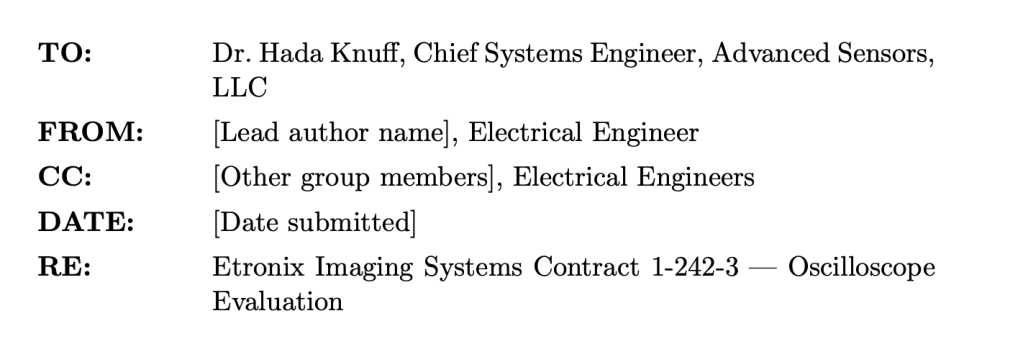
What your memo must do:
Lead with your conclusion. Dr. Knuff needs to know immediately whether the oscilloscope meets the EIS specifications — do not make her read to the end to find out. State your conclusion in the opening paragraph, then support it with the evidence that follows. This is standard professional practice: the reader gets the answer first, then the reasoning.
Your memo must include:
- A clear statement of whether the oscilloscope meets each EIS specification
- The oscilloscope settings used for each signal (vertical scale, timebase, trigger settings)
- Numerical verification that each signal meets the specifications — both the automated measurement from the oscilloscope and your manual division-count verification; report all values with appropriate units and uncertainty
- A waveform image for each signal, clearly labeled and referenced in the text
- An honest account of any deviations from specification and their likely causes
- A brief statement of the limitations of your measurement — what prevents you from claiming perfect agreement with the specifications
Write in professional prose. No bullet-point data dumps. Your audience is a technically literate engineer, not a physics professor — you do not need to explain basic concepts, but you do need to be precise about what you measured and what it means.
Authorship and Attribution
At the end of the memo, include a brief author contributions statement. Two or three sentences identifying who took the lead on which parts — for example, data collection, analysis, writing, figures. This mirrors standard practice in professional and scientific documents.
A Note on Learning Objectives
This memo is an opportunity to demonstrate several course learning objectives. A strong memo will show that you can:
- Communicate experimental results accurately and honestly to a specialist audience, in a narrative structure appropriate to that audience (objective 7)
- Represent your results in a way that is true to what the data shows, including its limitations (objectives 2 and 8)
- Contribute meaningfully to a jointly authored professional document (objective 9)
When you write your grade proposal, you can point to this memo as evidence for these objectives — but only if the memo actually does these things. A memo that claims the specifications are met without numerical evidence, or that omits limitations, does not demonstrate objective 8 regardless of how well it is written.
Submission
Submit your memo as a PDF to D2L by the due date. All group members should be listed. The lead author’s name should be clearly identified in the FROM line.
You saved waveform images to a flash drive during the lab session. You will need these for your memo. If you had trouble saving images during lab, contact your instructor before the due date.

