Explain the concept of exponential radioactive decay and its significance in medical physics.
Calculate the decay constant and understand its role in the decay process.
Apply the exponential decay law to determine the quantity of a radioactive substance over time.
Calculate and interpret the radioactive half-life of a substance.
Understand and calculate the activity of a radioactive sample, using appropriate units.
Exponential Behaviors
Radioactive Decay
Exponential Radioactive Decay Law
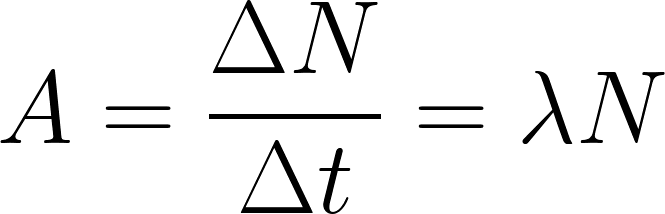
Activity
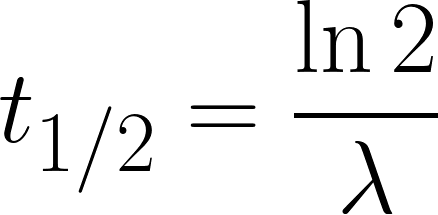
Half life
Practice!
Practice 4.1.1
The isotope, tritium, has a half-life of 12.3 years. Assume we have 10 kg of the substance. What will be the decay constant?
A. 5.6 x 10⁻² s–1
B. 5.6 x 10⁸ s–1
C. 3.2 x 10⁷ s–1
D. 1.8 x 10⁻⁹ s–1
E. 1.6 x 10⁶ s–1
Check your answer: D. 1.8 x 10⁻⁹ s–1
Practice 4.1.2
The isotope, tritium, has a half-life of 12.3 years. Assume we have 10 kg of the substance. What will be the initial decay rate, at t = 0 (in decays/s)?
A. 1.09 x 10¹⁴ decays/s
B. 1.8 x 10⁻⁹ decays/s
C. 5.6 x 10⁸ decays/s
D. 3.6 x 10¹⁸ decays/s
Check your answer: D. 3.6 x 10¹⁸ decays/s
Practice 4.1.3
The isotope, tritium, has a half-life of 12.3 years. Assume we have 10 kg of the substance. How much tritium will be left after 30 years?
A. 0.20 kg
B. 1.8 kg
C. 0.18 kg
D. 1.7 kg
E. 4.1 kg
Check your answer: B. 1.8 kg
Practice 4.1.4
Which sample contains a greater number of nuclei: a 5.00-µCi sample of 240Pu (half-life 6560 y) or a 4.45-µCi sample of 243Am (half-life 7370 y)?
A. The 240Pu sample
B. the 243Am sample
C. both have the same number of nuclei.
Check your answer: C. both have the same number of nuclei.
Discuss!
The isotope 57Co decays by electron capture to 57Fe with a half-life of 272 days. The 57Fe nucleus is produced in an excited state, and it almost instantaneously emits gamma rays that we can detect.
(a) Find the mean lifetime and decay constant for 57Co.
(b) If the activity of a 57Co radiation source is now 2.00 mCi, how many 57Co nuclei does the source contain?




 Physics Education Research at UNG